- Duration:
- 23 days
- Group Size:
- 4–8
- Tour Start:
- Nairobi
- Tour End:
- Nairobi
Central and Western Kenya: Birding and Wildlife Safari
Details
2027
08 – 30 July
Per person sharing
$10,960 USD
£8,693 GBP / €10,235 EUR
Single supplement
$2,280 USD
£1,808 GBP / €2,129 EUR
2028
08 – 30 July
Per person sharing
$12,165 USD
£9,648 GBP / €11,360 EUR
Single supplement
$2,530 USD
£2,007 GBP / €2,363 EUR
Itinerary
Download ItineraryCentral and Western Kenya: Birding and Wildlife Safari
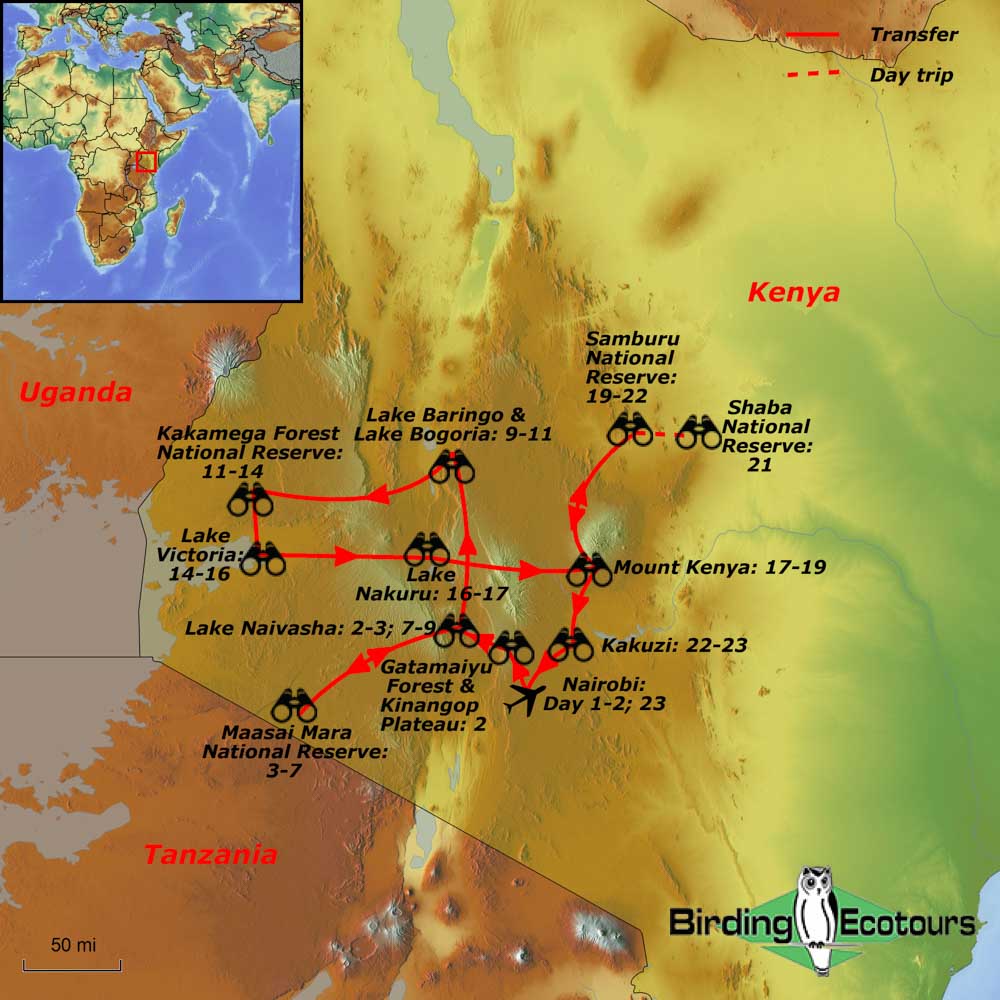
This 23-day birding and wildlife holiday in Kenya comprehensively covers the central and western regions of this spectacularly diverse East African country. Additionally, this trip offers a more premium experience than most birding tours in this amazing mammal- and bird-rich country; we use relatively spacious vehicles and comfortable accommodations, which are superior to those offered by other Kenya birdwatching holidays we’ve seen.
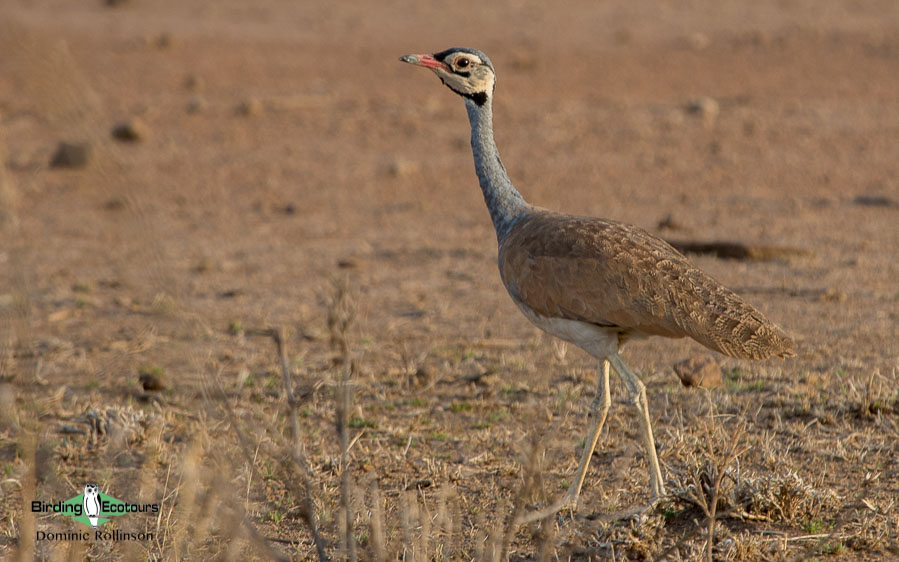
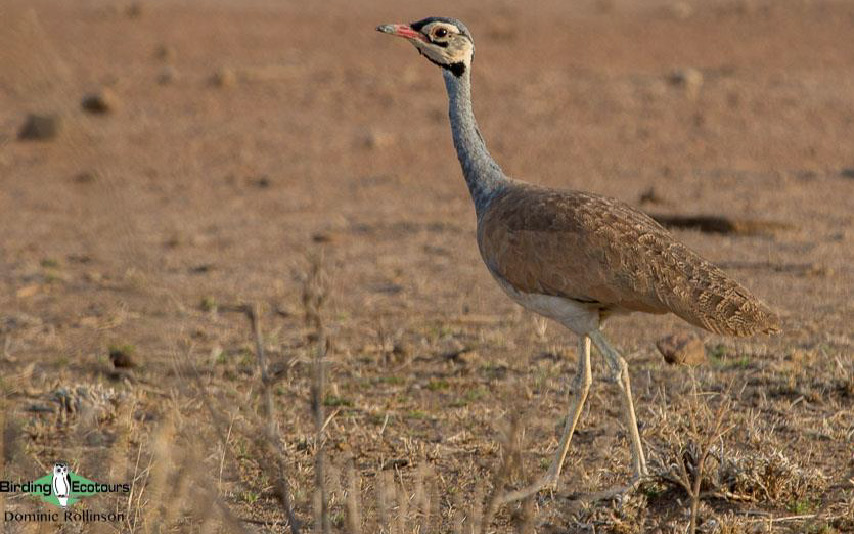 White-bellied Bustard should be seen on the plains of the Maasai Mara.
Kenya has a spectacularly diverse array of habitats packed into a small area. On this trip, we will explore the plains of the Maasai Mara, the papyrus swamps of Lake Victoria, the saline lakes of the Great Rift Valley, the lush montane forests of Mount Kenya, and the Acacia woodlands of Samburu National Reserve, to name only a few. We will encounter endless herds of wildlife, opportunistic predators such as Africa’s big cats, and a myriad of colorful bird species.
Kenya is smaller than Texas yet boasts an incredible 1,162 bird species. A relatively modest ten of these species are single-country endemics, but Kenya also boasts a range of East African endemics, including a number of species that occur only in Kenya and Tanzania. The country has 62 Important Bird Areas (IBAs) and some of the most famous game parks in the world, including the Maasai Mara and its endless migrating wildebeest herds, Amboseli with Mount Kilimanjaro as a backdrop, and many others.
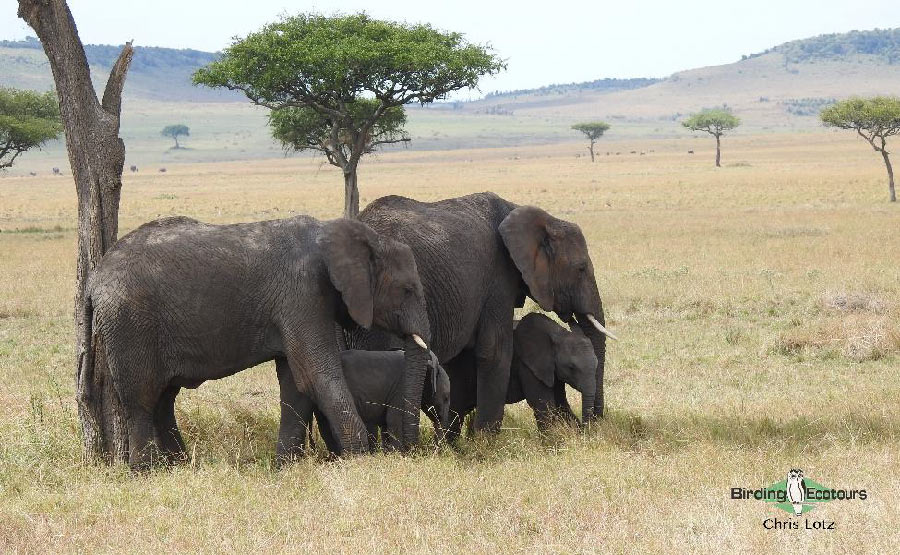 African Elephants with youngsters in the Maasai Mara.
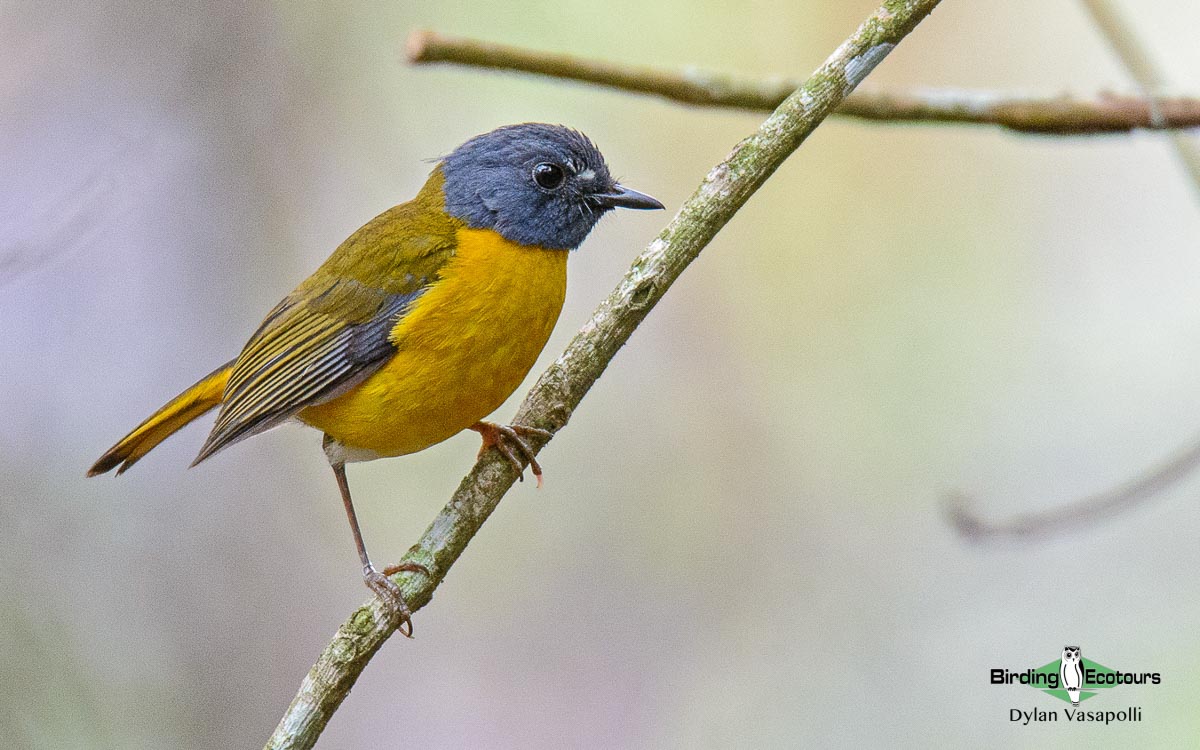
This comprehensive wildlife and birding vacation to Kenya should enable you to see around 500 bird species, enjoy excellent large game viewing, and allow you to see some of Africa’s most famous sites. While we appreciate all the wildlife, we are sure to spend adequate time looking for the localized bird specials of Kenya (and East Africa as a whole), including five of Kenya’s endemic birds: Hinde’s Babbler, Aberdare Cisticola, Williams’s Lark, Sharpe’s Longclaw, and Kikuyu White-eye. Other notable species include Jackson’s Spurfowl (essentially endemic to Kenya but occasionally reported from the Ugandan slope of Mount Elgon), Elgon Francolin, Grey-chested Babbler, Golden-winged Sunbird, Friedmann’s Lark, Donaldson Smith’s Sparrow-Weaver, Abbott’s Starling, Grey-crested Helmetshrike, and Turner’s Eremomela, among others.
This trip runs just before our Eastern Kenya: Amboseli, Taita Hills, and Coastal Specials tour, which targets the remainder of Kenya’s accessible endemic species. These two trips can be combined for a comprehensive 35-day Kenyan birding adventure, targeting all the country’s accessible endemic species (we only miss Tana River Cisticola, which hasn’t been recorded since the 1970s).
Itinerary (23 days/22 nights)
Day 1. Nairobi
Upon arrival at the Jomo Kenyatta International Airport (JKIA) in Nairobi, you will be met by our driver and tour leader and transferred to your hotel. If you arrive early, there might be time to visit the excellent Nairobi National Park. Here, Africa’s big game species (along with smaller animals such as Thomson’s Gazelle) can be seen right on the outskirts of Kenya’s capital. It’s also a rhino sanctuary and an Important Bird Area (IBA). We hope to get our bird list off to a good start with species like Saddle-billed Stork, Yellow-throated Sandgrouse, Martial Eagle (Africa’s largest eagle), Rüppell’s Vulture, Eastern Chanting Goshawk, Common Ostrich, Hartlaub’s Bustard, and the East African endemic Red-throated Tit and Northern Pied Babbler.
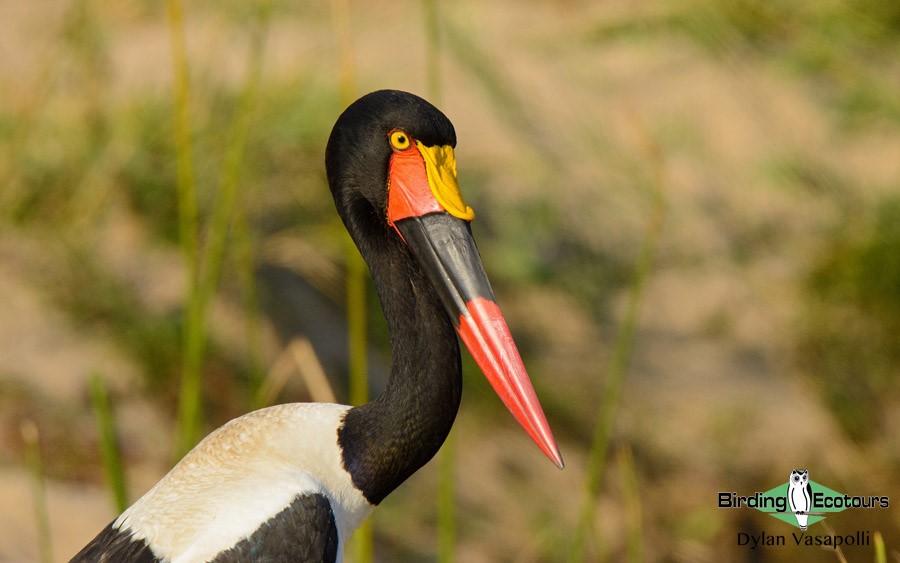
The impressive Saddle-billed Stork should be seen on this tour.
Near Nairobi is the Kikuyu Escarpment at the foot of the Aberdare Mountains. Both are IBAs with important Afrotropical highland montane species, including Abbott’s Starling, Black-fronted Bushshrike, Hunter’s Cisticola, Grey Cuckooshrike, Chestnut-throated Apalis, Grey Apalis, Mountain Greenbul, White-starred Robin, and the endemic duo of Aberdare Cisticola and Kikuyu White-eye, among many others.
Overnight: Nairobi
Day 2. Gatamaiyu Forest, Kikuyu Escarpment and the Kinangop Plateau Grasslands.
This morning, we will travel north of Nairobi to the Kinangop Plateau grasslands and the Aberdare Mountains in search of range-restricted grassland and forest species. Our first stop will see us working tussock-grasslands for the endemic and Endangered (BirdLife International) Sharpe’s Longclaw. Other species here may include Black-winged Lapwing, Augur Buzzard, Hunter’s and Wing-snapping Cisticolas, Kenya Sparrow, Streaky Seedeater, and the impressive Long-tailed and Jackson’s Widowbirds. The near-endemic Golden-winged Sunbird should also be seen today, although this is by no means the last chance at this relatively widespread (at least on our route) species. After spending some time in the grasslands, we will make our way up and into the Aberdare Mountains, where we hope to see the endemic duo of Aberdare Cisticola and Kikuyu White-eye. Another big target here is the essentially endemic Jackson’s Spurfowl. The diverse montane habitats here are home to many great birds, and we should get our first exposure to birds like Moorland Chat, Tacazze and Eastern Double-collared Sunbirds, Cinnamon Bracken Warbler, Brown Woodland Warbler, Chestnut-throated and Grey Apalis, Abyssinian Thrush, and White-eyed Slaty Flycatcher, to name a few.
After what promises to be an action-packed first day, we will make our way to the shores of Lake Naivasha in anticipation of visiting the famous Maasai Mara tomorrow!
Overnight: Elsamere Lodge, Naivasha
Day 3. Naivasha to Maasai Mara National Reserve
This morning, we’ll depart from Naivasha (returning to Naivasha after our time in the Maasai Mara) for the renowned Maasai Mara National Reserve, which is contiguous with the Serengeti, located just across the border in Tanzania. The drive will already present some special rewards, such as a sudden, surprising, and stunning outlook from a viewpoint at the top of the escarpment over the width of the Great Rift Valley, with Rock Hyraxes also enjoying the view. All kinds of spectacular birds along with large (and small!) game animals abound, including Grey Crowned Crane, Secretarybird, Common Wildebeest, Thomson’s Gazelle, Plains Zebra, Impala, Black-backed Jackal, Common Duiker, Vervet Monkey, and even (Maasai) Giraffe – roaming freely in the fields and using the roads together with the traffic, long before we even enter any game reserve.
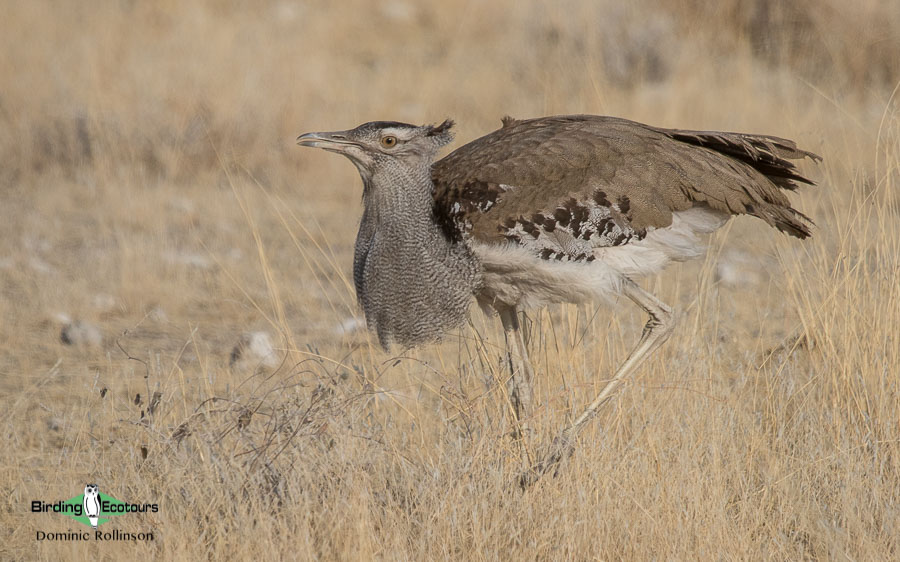
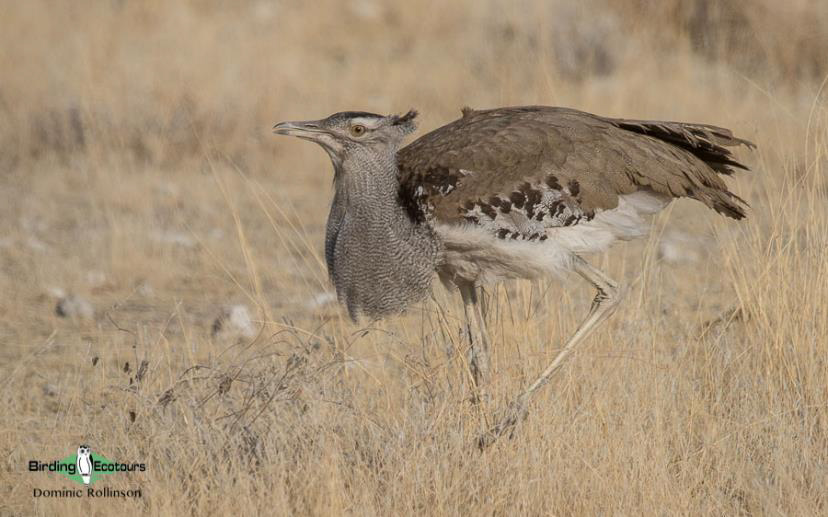 The massive Kori Bustard is often seen strolling across the open plains.
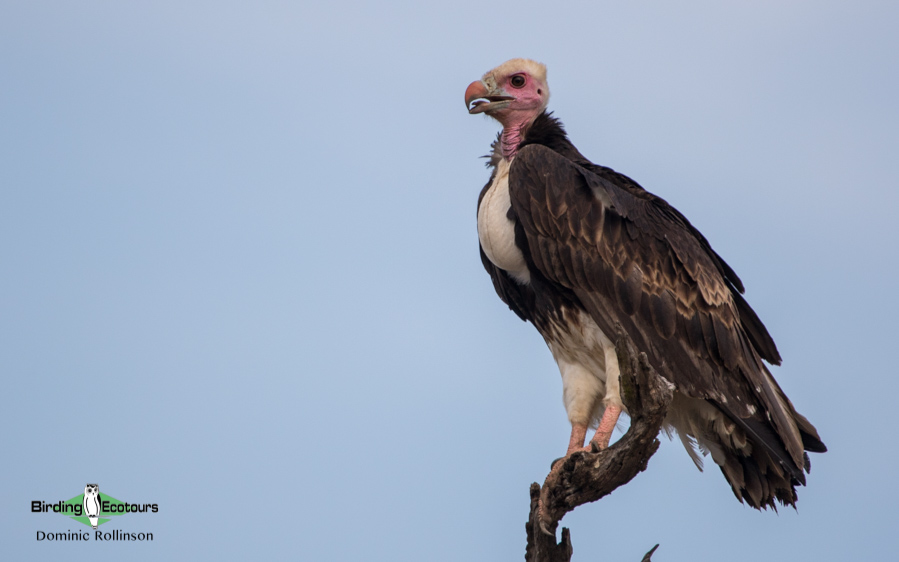
We’ll arrive in time for lunch and take an afternoon game drive for some of the big game animals and local birds like Kori Bustard (the world’s heaviest flying bird), several of the seven species of vultures here, including Egyptian, Hooded, Rüppell’s, Lappet-faced, and White-headed, Secretarybird, Coqui Francolin, Von der Decken’s Hornbill, Hildebrandt’s Starling, Red-fronted, Spot-flanked and Usambiro Barbets, Northern White-crowned Shrike, and Silverbird.
We will be arriving at the tail end of the iconic Common Wildebeest migration and expect to see both migratory and resident individuals dotted across the vast plains along with Plains Zebra and Topi.
Overnight: Serena Lodge, Mara Triangle
Day 4. Maasai Mara National Reserve
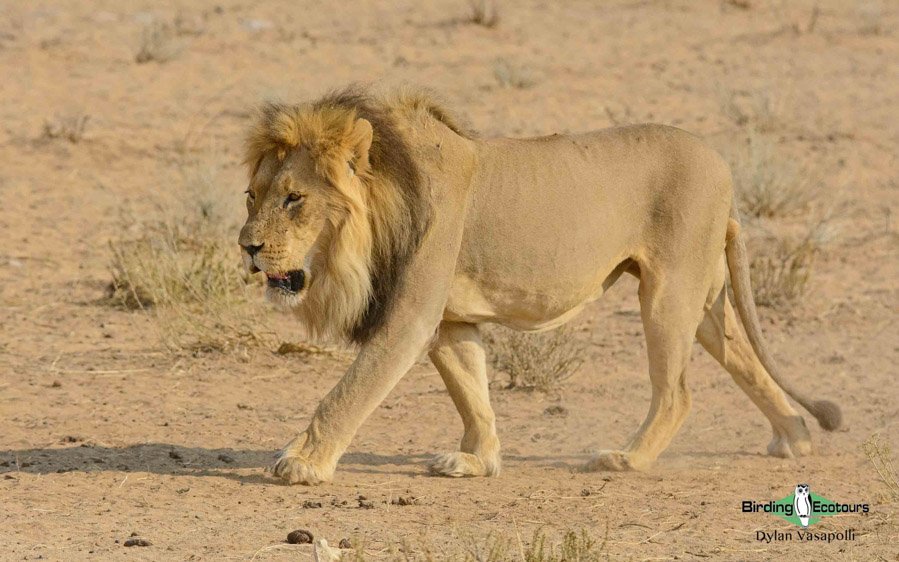
We will have a full-day birding experience in the park, accompanied by a picnic lunch. We’ll visit the Mara River, hoping to see part of the great wildebeest migration crossing the river, but this can, of course, not be guaranteed (the timing varies from year to year). We’ll also look out for the “big five”: African Elephant, Lion, Leopard, (Black and White) Rhinoceros, and African Buffalo. We should also see Hippopotamus and plains game, such as Thomson’s Gazelle, Topi, (Maasai) Giraffe, and Black-backed Jackal.
Birds we expect to see here include Red-necked Spurfowl, White-bellied and Black-bellied Bustards, a number of vulture species, plus many other raptors like the beautiful Long-crested Eagle, the gigantic Martial Eagle, Tawny Eagle, Wahlberg’s Eagle, Black-chested Snake Eagle, the colorful Bateleur (one of the most beautiful eagles!), Shikra, and African Goshawk. In the more open areas, we can expect to encounter several species of colorful Bee-eaters, such as Cinnamon-chested, Little and White-throated, Kingfishers such as Grey-headed and African Pygmy, and Rollers like Purple and Lilac-breasted. The grasslands and woodlands also hold species such as Coqui and Red-winged Francolins, Pygmy Falcon, Southern Ground Hornbill, Fischer’s Sparrow-Lark, Foxy Lark, Taita Fiscal, Trilling Cisticola, Rufous-tailed and Speckle-fronted Weavers, Red-cheeked Cordon-bleu, and many others.
Overnight: Serena Lodge, Mara Triangle
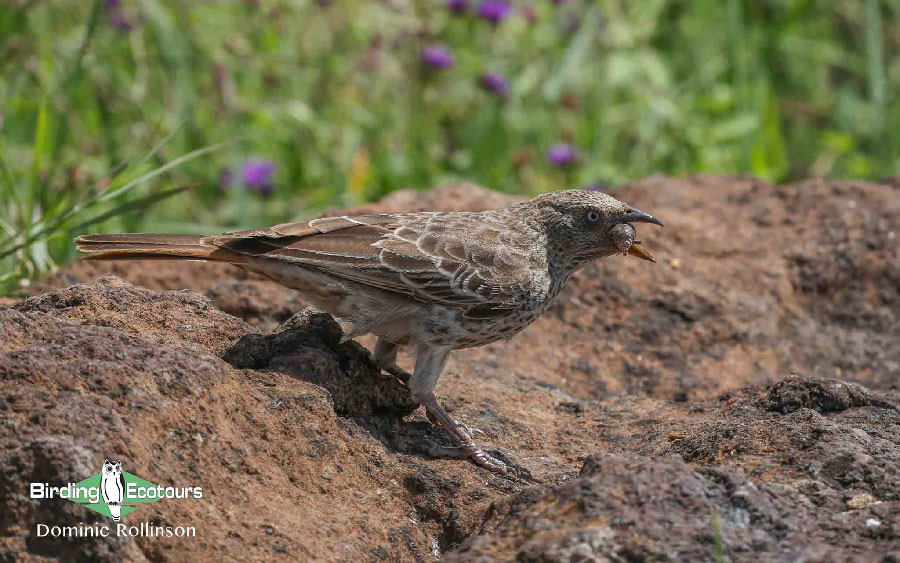 Although nearly endemic to Tanzania, Rufous-tailed Weaver makes it into the Maasai Mara.
Days 5 – 6. Maasai Mara National Reserve
We plan to spend an additional two full days in the Maasai Mara to maximize our chances of connecting with the special birds and mammals of this incredible part of the world. We can have a pre-breakfast cup of coffee and tea before our early morning game drives, after which we will return to our lodge for a proper sit-down breakfast. We will carry a picnic lunch and stay out for most of the day looking for different wildlife (as mentioned above). We also hope to enjoy large herds of wildebeest and will look out for possible wildebeest river crossing sites.
Overnight: Serena Lodge, Mara Triangle
Day 7. Maasai Mara to Lake Naivasha
After breakfast, we depart for Lake Naivasha, arriving in time for lunch. Lake Naivasha is a birdwatcher’s paradise, with nearly 500 species recorded from the area. Our afternoon birding may yield Tropical Boubou, Orange-breasted Bushshrike, White-headed Barbet, Variable Sunbird, the dazzling Purple Grenadier, White-bellied Tit, White-browed Robin-Chat with its beautiful song, the arid country specialist Buff-bellied Warbler, and Red-faced Crombec. Along the edge of the lake, we hope to find Yellow-billed Stork, Long-toed and Spur-winged Lapwings, Malachite Kingfisher, and Pink-backed Pelicans.
Overnight: Elsamere Lodge, Naivasha
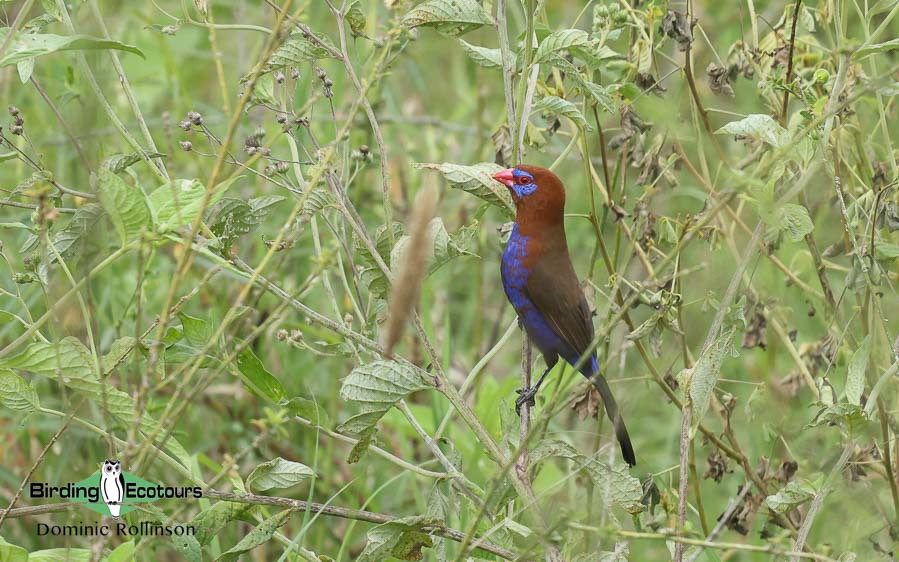 The gorgeous Purple Grenadier is common on this tour.
Day 8. Lake Naivasha, Crescent Island Game Park
We will wake up early and do some pre-breakfast birding. After breakfast, we’ll head for Crescent Island, a private wildlife game sanctuary on the eastern side of Lake Naivasha. It was created in 1988 and, following a sudden drop in water levels in 2000, Crescent Island became part of the mainland and is now a peninsula. Big game animals, including Plains Zebra, Thomson’s Gazelle, Impala, and (Maasai) Giraffe, can all usually be seen up close. Other wildlife includes (Defassa) Waterbuck, Common Eland, and Common Wildebeest.
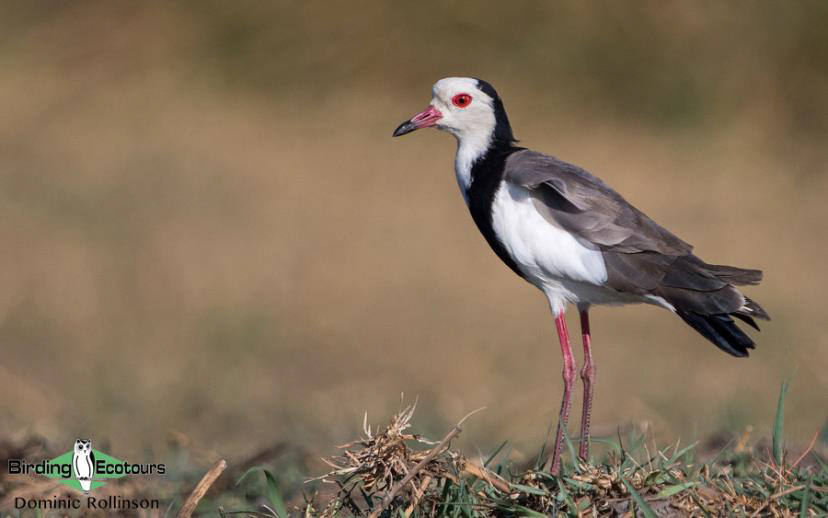 The strikingly colored Long-toed Lapwing can be seen at Lake Naivasha.
Up to 80 waterbird species have been recorded during censuses, including White-backed Duck, Saddle-billed Stork, Marabou Stork, African Spoonbill, Great Crested Grebe, the ubiquitous but attractive African Jacana, and various striking lapwing species such as Long-toed and Spur-winged Lapwings.
We also hope to find the localized, Near Threatened (BirdLife International) Grey-crested Helmetshrike, the personality-filled Grey-capped Warbler, Hildebrandt’s Spurfowl, White-bellied Tit, Nubian and Eastern Grey Woodpeckers, Black-lored Babbler, Rüppell’s and Superb Starlings, and a wide variety of more widespread terrestrial birds such as Black-headed Oriole, Red-chested Cuckoo, Pearl-spotted Owlet, Grey-backed and Northern Fiscals, along with many others (in Kenya, there are birds everywhere, and just so many different species!). Mottled and Nyanza Swifts should also be seen foraging in this area.
Overnight: Elsamere Lodge, Naivasha
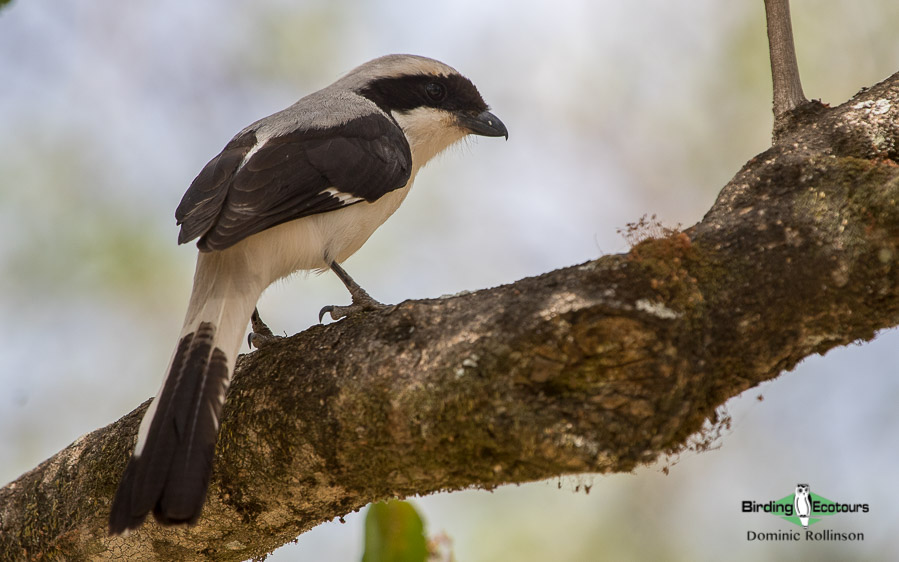
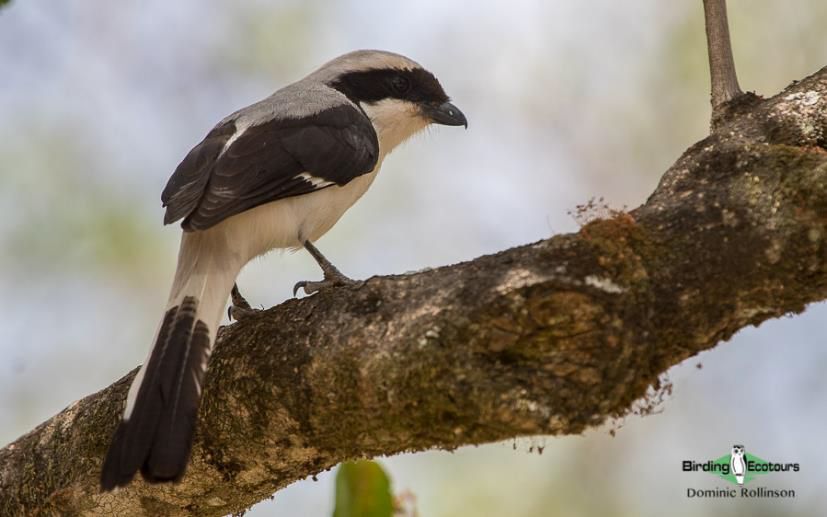 Grey-backed Fiscal may be seen at Lake Nakuru National Park.
Day 9. Lake Naivasha to Lake Bogoria National Reserve
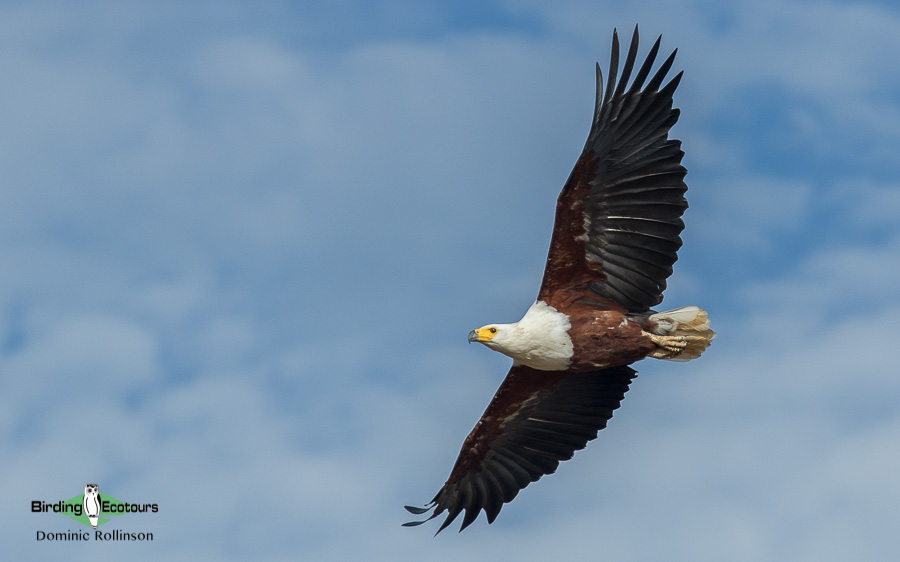
After an early breakfast, we will check out and depart towards the incredible Lake Bogoria National Reserve, planning to arrive at Lake Bogoria Spa Lodge in time for lunch. We plan to make a few stops along the way, which may yield White-bellied Go-away-bird, Blue-naped Mousebird, Northern Red Bishop, Beautiful Sunbird, and Spotted Palm Thrush. After lunch, we will drive to the Lake Bogoria National Reserve. Unlike Lake Nakuru, whose salinity level has been affected by an increased water volume, Bogoria’s water salinity has not been affected. Hence, the lake has retained the spirulina (blue-green algae), which is the food of Lesser Flamingo, and we hope to see large numbers here (they have vanished from Lake Nakuru due to rising water levels). We might also see Greater Flamingo, Black-necked Grebe, Steppe Eagle, Tawny Eagle, African Fish Eagle, and, as usual, a host of other interesting species in the nearby woodlands, such as Pygmy Batis, Slate-colored Boubou, Nubian Woodpecker, Red-fronted and Red-and-yellow Barbets, Northern Red-billed Hornbill, Pygmy Falcon, and the near-endemic Jackson’s Hornbill.
Overnight: Lake Bogoria Spa (we’ve had to tweak our itinerary in recent years because of flooding of the Rift Valley lakes and two hotels being submerged!).
Day 10. Lake Baringo National Reserve: cliff specialists, boat ride, and more
After breakfast, we head to Lake Baringo early in the morning. We arrive and meet our coxswain, ready to take us birding by motorboat. Unlike Lake Bogoria, just a few miles away, Lake Baringo is a freshwater lake, which means a different mix of waterbirds. Some of the birds we expect to see here include Goliath Heron, Hamerkop, Senegal Thick-knee, Gull-billed Tern, Grey-headed Kingfisher, the dazzling Northern Carmine Bee-eater, and Golden-backed Weaver, among others. This is also one of the best sites in the world to see Northern Masked Weaver.
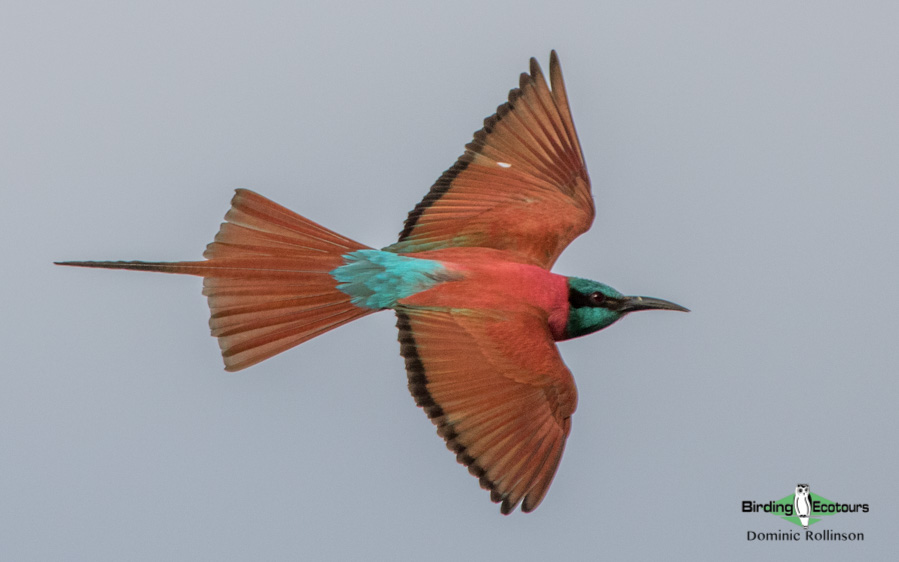 The vivid colors of Northern Carmine Bee-eater will leave you awestruck.
After a two-hour boat ride, we have an hour or so to search for terrestrial beauties here, like Eastern Violet-backed Sunbird, Spotted Palm Thrush, Parrot-billed Sparrow, and Abyssinian Roller, among others, before we break for lunch. In the late afternoon, we resume birding, now along the cliffs, looking for Hemprich’s Hornbill, Bristle-crowned Starling, Verreaux’s Eagle, and Rock Hyrax, the eagle’s main prey. With the help of a local naturalist, we’ll walk along the famous Tugen Hills, known for their great diversity of raptors and owls, as well as interesting passerines. Here, we hope to find Three-banded Courser, Slender-tailed Nightjar, Greyish Eagle-Owl, Verreaux’s Eagle-Owl, Pearl-spotted Owlet, Lichtenstein’s Sandgrouse, White-bellied Canary, Brown-tailed Rock Chat, Jackson’s Hornbill, Speckle-fronted Weaver, White-billed and White-headed Buffalo Weavers, Dark Chanting Goshawk, African Grey and Nubian Woodpeckers, Red-and-yellow and D’Arnaud’s Barbets, and Purple Roller, and many others.
Overnight: Lake Bogoria Spa
Day 11. Lake Baringo to Kakamega Forest National Reserve
We’ll do a pre-breakfast bird walk, and after we’ve eaten, we’ll drive to the Kakamega Forest National Reserve. This drive takes us through the beautiful scenery of the Kerio Valley. We will stop in the valley for a picnic lunch and do some birding, looking for White-crested Turaco, Beautiful Sunbird, Orange-breasted and Grey-headed Bushshrikes, Black-headed Gonolek, White-headed Saw-wing, and White-crested Helmetshrike, among others.
Kakamega Forest is Kenya’s only true tropical rainforest, similar to those found in central and west Africa. This area is alive with birds, some of which are found nowhere else in the country. We will have three full days to explore this diverse forest.
Overnight: Rondo Retreat Center, Kakamega Forest
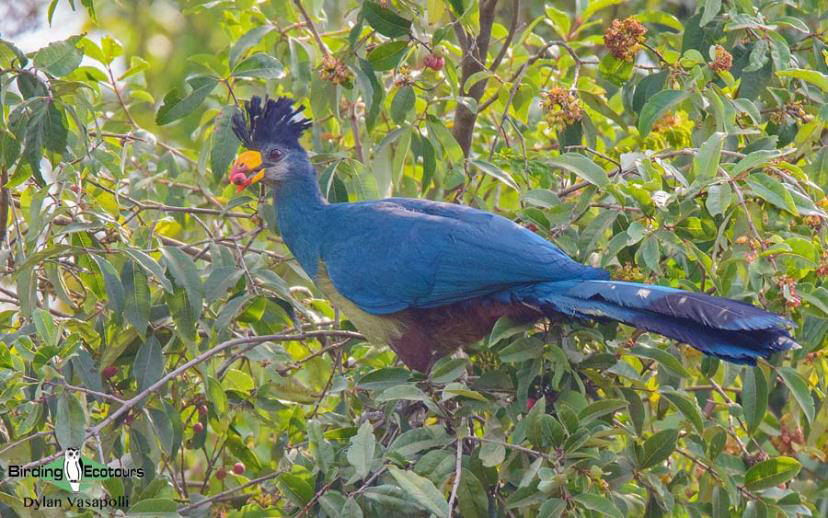 Great Blue Turaco is loud and conspicuous in Kakamega Forest.
Days 12 – 13. Kakamega Forest National Reserve
We will spend three full days enjoying the sights and sounds of this unique forest. We’ll walk the numerous forest trails here in search of many of Kakamega’s 350-odd bird species. The forest is West African in character, and many birds’ Kenyan distributions are confined to this forest, here at the eastern extent of their range, only marginally making it into this country. The rainforest is also a haven for butterflies and other insects, along with its vast avian riches.
In this tropical greenhouse, we’ll get a chance to see Great Blue Turaco, Blue-headed Bee-eater, Brown-eared, Yellow-crested and Buff-spotted Woodpeckers, Lühder’s Bushshrike, White-headed Wood Hoopoe, Joyful, Cabanis’s, Slender-billed and Shelley’s Greenbuls, Red-tailed Bristlebill, the gem-like African Emerald Cuckoo, and the cacophonous Black-and-white-casqued Hornbill. The forest is well-known for scarce and localized forest barbets, including the stunning Yellow-billed Barbet as well as Grey-throated and Hairy-breasted Barbets. The forest has a Near-Threatened (BirdLife International) high canopy warbler species, Turner’s Eremomela, which we will scan for in canopy bird parties. Another top target is Grey-chested Babbler, a Kakamega Forest special, with Kakamega as its genus and sometimes common name. The area also has a small population of the Endangered (BirdLife International) Grey Parrot, a species that, with some luck, can be found here (although it is much easier on our West African tours, such as to Ghana).
Kakamega Forest also supports good populations of three species of wattle-eyes, including Yellow-bellied, Jameson’s, and Chestnut Wattle-eye. The shy White-spotted Flufftail is sometimes seen along streams near Rondo Lodge. The forest here is dense and pristine with tall tree canopies, where species like Western Oriole, Red-headed Malimbe, Stuhlmann’s Starling, Sharpe’s Drongo, and many others can be searched for.
A range of primate species, such as Blue and Red-tailed Monkeys, beautiful Guereza (Black-and-white Colobus), as well as De Brazza’s Monkey, can also be seen in this forest. Approximately 40% of Kenya’s butterfly species are found in the Kakamega Forest as well. We’ll also have the opportunity to experience more of the diverse African culture of the Luhya people.
Overnight: Rondo Retreat Center, Kakamega Forest
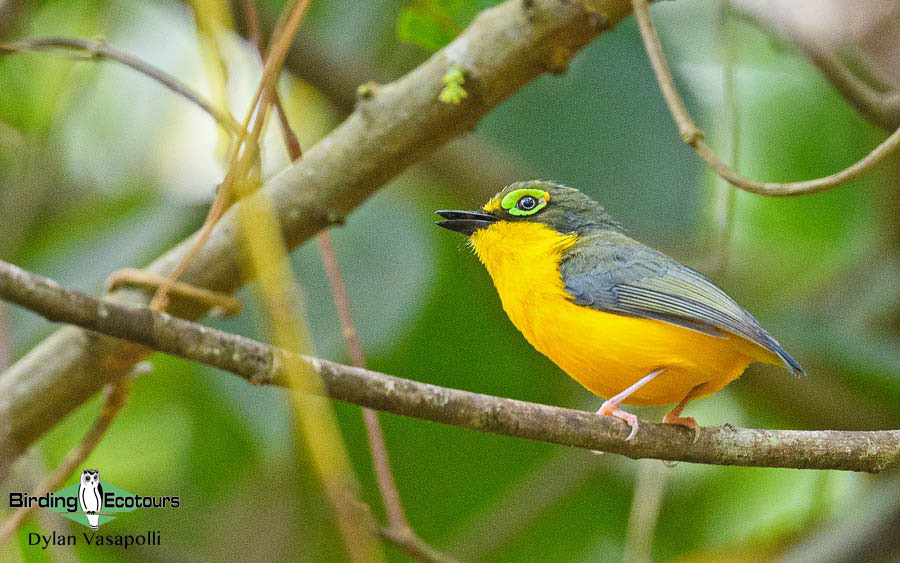 The brightly colored Yellow-bellied Wattle-eye is found in Kakamega Forest.
Day 14. Kakamega Forest to the shores of Lake Victoria
We will start the day with an early breakfast and then bird along the trails of Kakamega Forest for the last time on this trip. At midday, we will return to the lodge for lunch and then start our one-hour transfer south to the shores of Lake Victoria. Lake Victoria is Africa’s largest freshwater body and the second-largest freshwater lake in the world. The lake borders three East African countries: Kenya, Uganda, and Tanzania. Most of it is located in Tanzania (49%) and Uganda (45%), with Kenya having the smallest portion (6%). It is the source of the mighty Nile River, which flows north to Egypt. The reed beds around the lake provide a unique habitat for a few papyrus specialists, including Papyrus Gonolek, Papyrus Canary, Swamp Flycatcher, and Carruthers’s Cisticola. Also present here are many strikingly-colored weavers such as Black-headed, Village, Northern Brown-throated, Golden-backed, and Slender-billed Weavers. We aim to arrive here in the afternoon and will spend the afternoon birding along the shore of Lake Victoria, connecting with widespread species like African Openbill, Yellow-billed Stork, African Jacana, Spur-winged Lapwing, Eastern Plantain-eater, Blue-headed Coucal, Double-toothed Barbet, Winding Cisticola, Red-chested Sunbird, and more. We will also have our first chance at the papyrus specialists this afternoon; however, our boat ride tomorrow offers better opportunities for these species. After what is sure to be an exciting afternoon, we will make our way to our accommodation on the shores of Lake Victoria.
Overnight: Lake Victoria
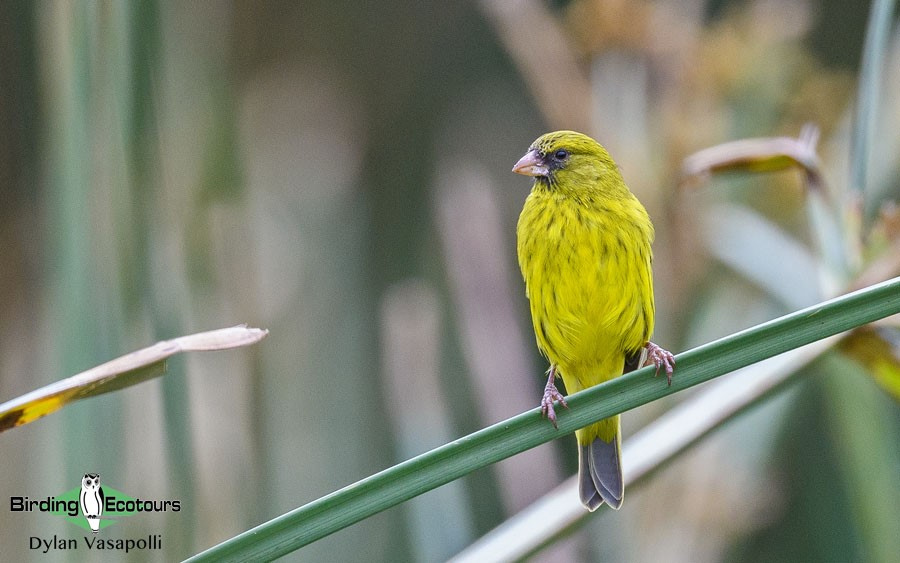 Papyrus Canary is one of a few papyrus specials that we target on the shores of Lake Victoria.
Day 15. Lake Victoria
Today, we will team up with a local guide and coxswain for a boat ride on the lake looking for the abovementioned papyrus specials. After a few hours on the lake, we will make our way back to our accommodation for lunch and will spend the afternoon birding along the shoreline.
Overnight: Lake Victoria
Day 16. Lake Victoria to Lake Nakuru National Park
We will have another opportunity early this morning to try for any of the papyrus specials, should we have missed them the previous day. After breakfast, we’ll depart for Lake Nakuru National Park, allowing time to search for several key species along the way. A prominent rocky escarpment en route is a favorite roosting spot for Mackinder’s Eagle-Owl, the northern subspecies (sometimes split into its own species) of Cape Eagle-Owl.
In the afternoon, we’ll arrive at Lake Nakuru National Park, where, in previous years, vast numbers of Lesser Flamingos used to feed in the shallow alkaline water, now replaced with smaller numbers of Greater Flamingos because of a change in the lake’s salinity. Lake Nakuru National Park was recently named an IBA by BirdLife International due to the huge bird populations and diversity in this magnificent park.
The Acacia scrub is a favorite haunt for Little Rock Thrush, Mocking Cliff Chat, Pale Flycatcher, and Purple Grenadier. Exploring the Acacia woodland and lakeside marshes, we will no doubt come across many other wonderful avian delights in addition, such as Great White Pelican, African Harrier-Hawk, Hildebrandt’s Spurfowl, Levaillant’s Cuckoo, White-browed Coucal, Green Wood Hoopoe, White-headed Barbet, Red-throated Wryneck, African Grey Woodpecker, Anteater Chat, Grey-backed Fiscal, Brown-crowned Tchagra, and African Firefinch.
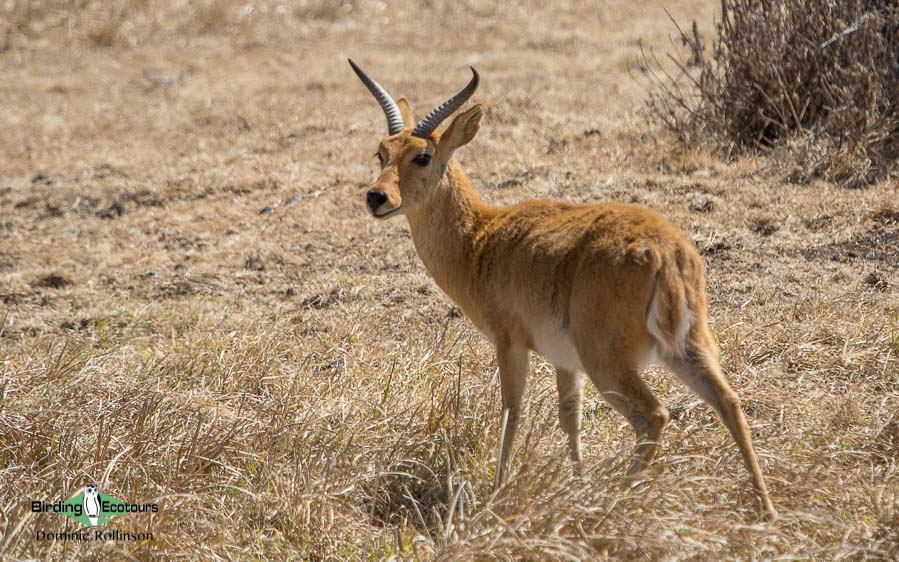
Mammals are also quite common in the park, and this is one of the few places in East Africa where both the endangered White and Black Rhinoceroses can be found. Some of the other mammals we hope to encounter are (Rothschild’s) Giraffe and Bohor Reedbuck.
We plan to spend the afternoon exploring the park before heading to our wonderful lodge for dinner.
Overnight: Sarova Lion Hill Lodge, Nakuru National Park
Day 17. Lake Nakuru National Park to Mount Kenya
We’ll depart, after breakfast, for Mount Kenya, allowing time to search for several key species along the way. We will also make a stopover at Thomson’s Falls in Nyahururu, which is one of Kenya’s highest towns, located at 7,700 feet (2,360 meters) above sea level. Just outside the town lies Thomson’s Falls on the Ewaso Narok River. It falls an impressive 230 feet (72 meters), with the mist feeding the dense forest below. At Thomson’s Falls, we’re likely to see Chestnut-winged and Slender-billed Starlings, Red-throated Rock Martin, Grey Cuckooshrike, Chestnut-throated Apalis, and Tacazze and Collared Sunbirds.
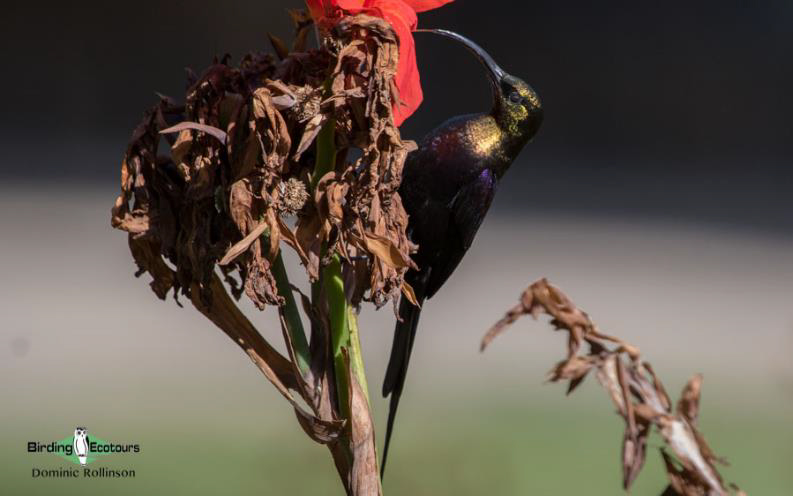 Tacazze Sunbird is one of the many beauties we will look for at Thomson’s Falls.
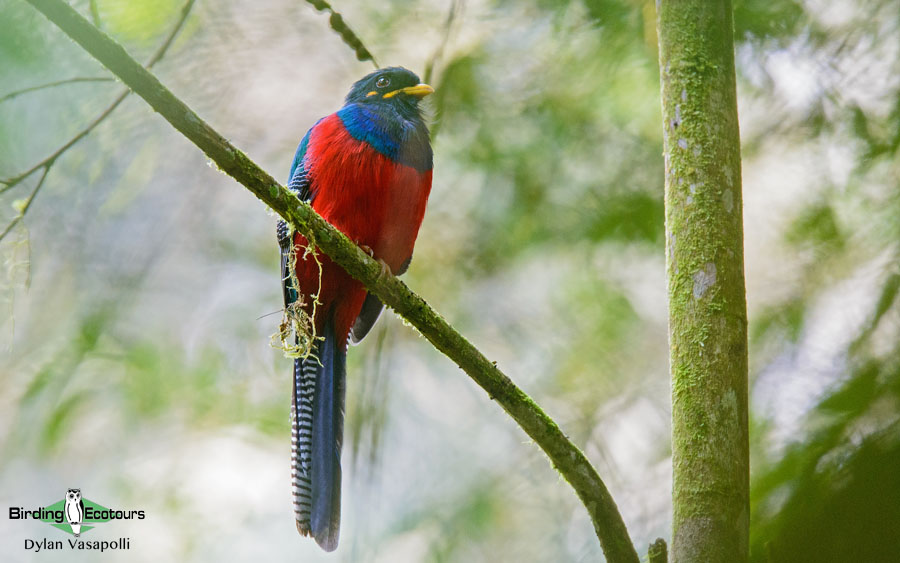
In the afternoon, we will arrive on the forested slopes of the mighty Mount Kenya – Africa’s second-highest peak at 17,060 feet (5,199 meters)! Our lodge is situated on the southern slopes of Mount Kenya, surrounded by lush montane forests. During our first birding session, we may encounter species like Hartlaub’s Turaco, Grey, Black-collared, and Black-throated Apalis, Mountain Oriole, Red-fronted Parrot, Silvery-cheeked Hornbill, Bar-tailed Trogon, Kikuyu Mountain Greenbul, African Hill Babbler, Kandt’s Waxbill, Scarce Swift, and Black-fronted Bushshrike, among so many other fantastic birds.
Arguably, our main target here is Olive Ibis, and we will have our first opportunity at this much-wanted bird today. In the evening, we will listen out for the calls of Montane Nightjar, a specialist of the highlands, as the name suggests.
Overnight: Castle Forest Lodge, Mount Kenya
Day 18. Mount Kenya
We’ll be up early this morning and start with what promises to be a productive session in the montane forests around the lodge. We will look for many of the same species mentioned in the write-up for our first day at Mount Kenya and will have the whole day to try for any species that we may have missed yesterday. Other birds that we may see today include Scaly and Jackson’s Spurfowls, Crowned Eagle, Yellow-whiskered and Slender-billed Greenbuls, Eastern Bronze-naped Pigeon, Moustached Tinkerbird, African Emerald Cuckoo, Fine-banded Woodpecker, Grey and Purple-throated Cuckooshrikes, Abyssinian Ground Thrush, White-browed Crombec, Mountain Yellow Warbler, Waller’s, Abbott’s and Sharpe’s Starlings, Grey-headed Nigrita, Abyssinian Crimsonwing, and Yellow-bellied Waxbill, to name only a few.
Also of interest here are primates, and we will look out for the impressive Guereza and Blue Monkey.
We will spend the entire day birding in the forests and return to our accommodation in preparation for the drive to Samburu National Reserve the following day.
Overnight: Castle Forest Lodge, Mount Kenya
Day 19. Mount Kenya to Samburu National Reserve
After breakfast and a final birding session on the lush slopes of Mount Kenya, we will make our way north to Samburu National Reserve.
This is one of our longer drives, roughly four hours; however, we will take birding stops along the way, which will allow us to stretch our legs and enjoy more of Kenya’s magnificent birdlife. In particular, we will keep our eyes open for spectacular Long-tailed and Red-collared Widowbirds along the roadside. Time-dependent, we may make a detour to try for the mega Elgon Francolin. This francolin is a seldom-seen species and is near-endemic to Kenya, inhabiting highland grasslands and moorlands.
Samburu is an arid reserve, presenting us with some new species as described for the next day. Our hosts here are the Samburu people, who are pastoralists, herding their cattle like their cousins in the south, the Maasai. We will search for game animals as we make our way to our lodge and will have a chance for an evening game drive in search of the many birds and animals that inhabit this impressive park.
Overnight: Samburu Simba Lodge
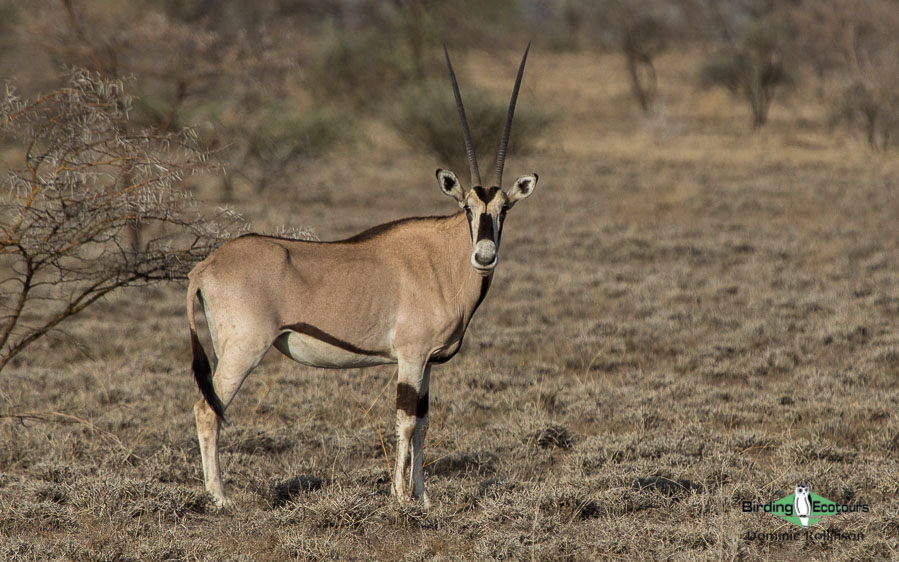
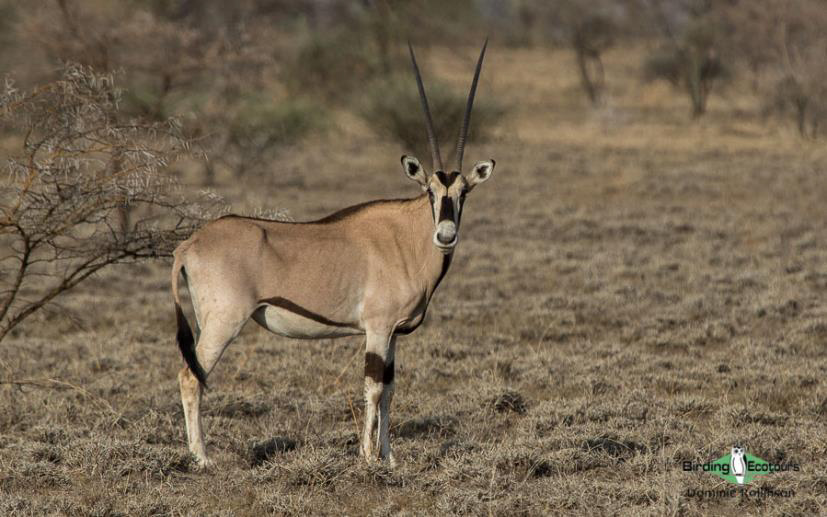 Samburu National Reserve is home to large numbers of mammals, including this impressive Beisa Oryx.
Day 20. Samburu National Reserve
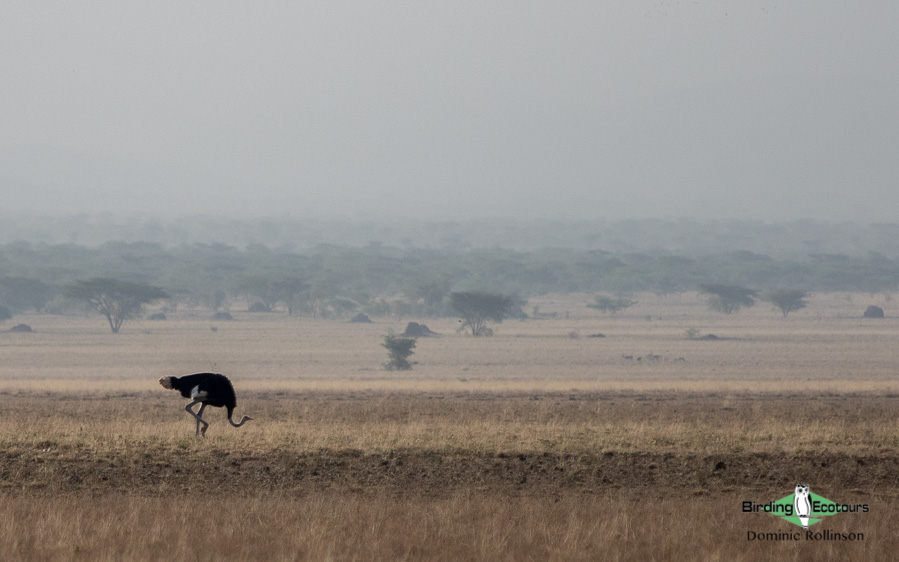
Samburu is one of the most exciting reserves in Kenya, perhaps even in greater East Africa, with the semi-desert habitat and rich woodlands along the Ewaso Ng’iro River teeming with wildlife. Exploring this fantastic reserve will always produce a most overwhelming array of bird species, such as Somali Ostrich, African Hawk-Eagle, Crested Francolin, Yellow-necked Spurfowl, impressive Vulturine Guineafowl, Kori, Buff-crested and White-bellied Bustards, Black-faced, Chestnut-bellied and Lichtenstein’s Sandgrouse, Red-bellied Parrot, Somali Bee-eater, Von der Decken’s Hornbill, stunning Red-and-yellow Barbet, Violet (Grant’s) Wood Hoopoe, Pink-breasted, Foxy and Red-winged Larks, truly beautiful Rosy-patched Bushshrike, Hunter’s, Tsavo and Black-bellied Sunbirds, Golden-breasted and Fischer’s Starlings, the near-endemic Donaldson Smith’s Sparrow-Weaver, Golden Palm Weaver, and Cut-throat Finch. Also found here is the cute White-headed Mousebird, to complete the set of all three Kenyan mousebird species (mousebirds are a charismatic, uniquely African family of wonderfully long-tailed, crested birds), among many other Maasai-Somali biome species.
Mammal life here is also prolific, with many species not seen elsewhere on our tour. Just a few of the many possibilities include Olive Baboon, Grevy’s Zebra, Dwarf Mongoose, Grevy’s Zebra, Giraffe (Maasai and Reticulated subspecies), Kirk’s and Guenther’s Dik-dik, (Coke’s) Hartebeest, Waterbuck, Gerenuk, Grant’s and Thomson’s Gazelle and the splendid Beisa Oryx.
Overnight: Samburu Simba Lodge
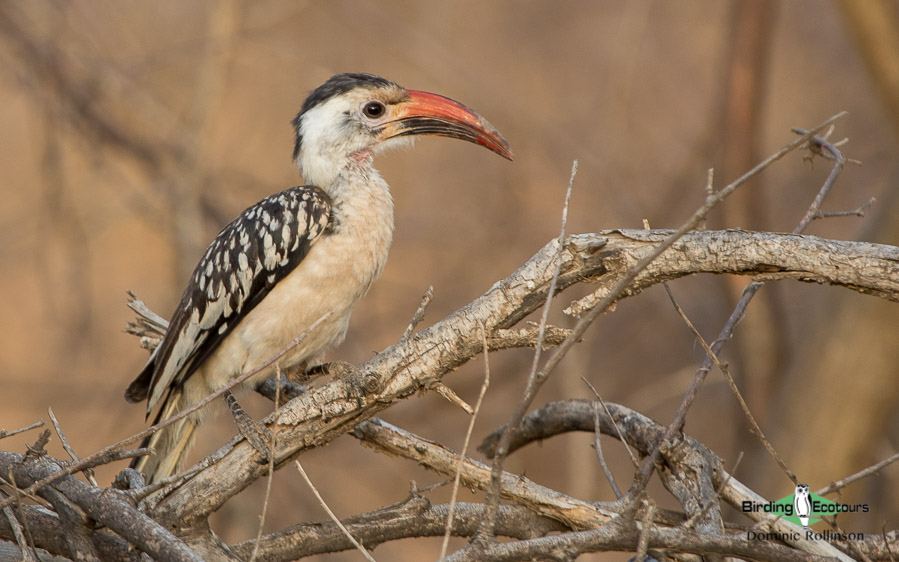
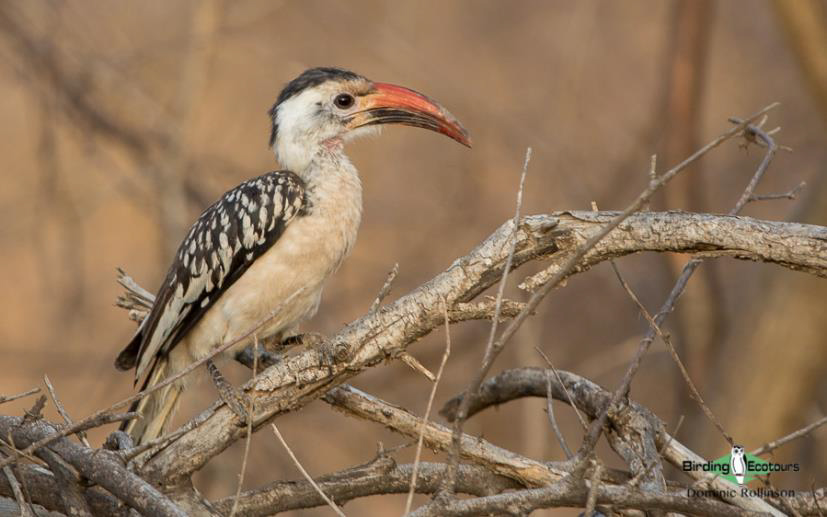 Northern Red-billed Hornbill is one of a number of hornbill species we should see in Kenya.
Day 21. Shaba National Reserve
The plan for today is to have breakfast at our accommodation in Samburu before heading to Shaba National Reserve. Much like Samburu, the reserve comprises mostly low-lying plains with several swamps and springs.
We can expect to see many of the birds that occur at Samburu here, and our primary target for today is the localized and endemic Williams’s Lark. Several other lark species can be seen in this area, such as the scarce Masked Lark and the enigmatic and poorly known Friedmann’s Lark; however, the latter species is unpredictable in its occurrence. More common larks here include Chestnut-headed and Fischer’s Sparrow-Larks, and Pink-breasted and Red-winged Larks.
We will return to our accommodation at Samburu for our final night in this delightful reserve.
Overnight: Samburu Simba Lodge
Day 22. Samburu National Reserve to Kakuzi
We leave Samburu soon after breakfast and drive southwards towards Nairobi, spending the night at Kakuzi – an agricultural area with excellent birding opportunities. Birding along the way, we proceed past the semi-arid Northern Frontier District into the Mount Kenya region. En route, we will pass through spectacular scenery, with the grasslands along the roadside offering a great place to spot Black-winged Lapwing, Black-winged Kite, Dusky Turtle Dove, Cape Crow, Long-tailed Widowbird, and Speke’s Weaver.
After crossing the equator, we enter the Central Kenya Highlands between the Aberdare Mountains and Mount Kenya. On a clear day, we may get glimpses of the snow-capped peaks of Mount Kenya. Making our way farther south out of the Central Kenya Highlands, we’ll see the pineapple plantations of Thika and many Kikuyu subsistence farms, and we plan to spend the night at Kakuzi Farm to try for the endemic Hinde’s Babbler and the much-wanted Northern Pied Babbler. Other species that may be seen here include Spot-flanked Barbet, Rüppell’s Robin-Chat, Red-cheeked Cordon-bleu, and Orange-winged Pytilia, among many others.
Overnight: Kakuzi
Day 23. Departure
We will have a final birding session this morning before taking the short one-hour drive to Nairobi. Our Kenyan birding adventure will conclude at noon today, and you are free to depart at any time. For those joining our Eastern Kenya: Amboseli, Taita Hills, and Coastal Specials tour, we will depart for Amboseli National Park tomorrow.
Please note that the itinerary cannot be guaranteed as it is only a rough guide and can be changed (usually slightly) due to factors such as availability of accommodation, updated information on the state of accommodation, roads, or birding sites, the discretion of the guides, and other factors. In addition, we sometimes have to use a different guide from the one advertised due to tour scheduling or other factors.
Map