- Duration:
- 14 days
- Group Size:
- 6–10
- Tour Start:
- Kagoshima
- Tour End:
- Tokyo
Birding Tour Japan: Spectacular Winter Birds
Details
2027
21 February–06 March
Per person sharing
$8,950 USD
£6,935 GBP / €8,079 EUR
Single supplement
$750 USD
£581 GBP / €677 EUR
In the event of fewer than six participants signing up to the tour there will be the option of a surcharge to guarantee departure. The amount of the surcharge will depend on how many participants are signed up to the tour and will occur if all participants agree.
The costs of this trip are tied to the Japanese Yen, and in the unlikely chance that the US$/Yen exchange rate changes more than we expect, there is a small chance there will be a price adjustment
Itinerary
Download ItineraryJapan: Spectacular Winter Birds
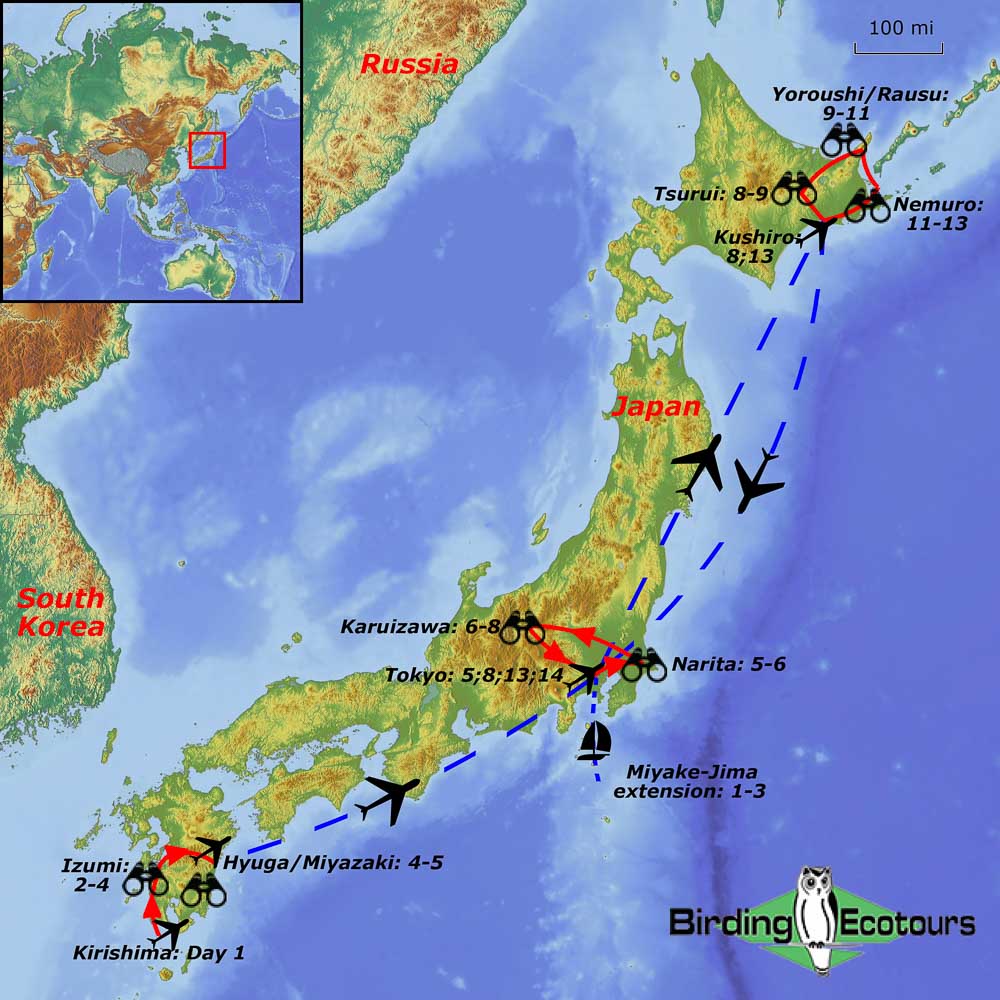
Japan is an archipelago of 6,852 islands, covering a huge area of 145,937 square miles (377,975 square kilometers) along the ‘Pacific Ring of Fire’, offering some world class birding. We will visit three of the five main islands (Kyushu, Honshu, and Hokkaido) on this exciting winter birding tour of Japan. This Japanese bird tour will start in Kirishima and end in Tokyo, Japan’s high-tech capital and largest city (though which also offers great birding along the edge of Tokyo Bay). Although one of the most populous countries in the world, around 75% of Japan is mountainous, with much of that area uninhabitable, so the population is crammed into multiple mega-cities. Japan has a fascinating cultural history and is unlike anywhere else in the world, and we will get a great sample of this as we travel around on our Japanese birdwatching tour.
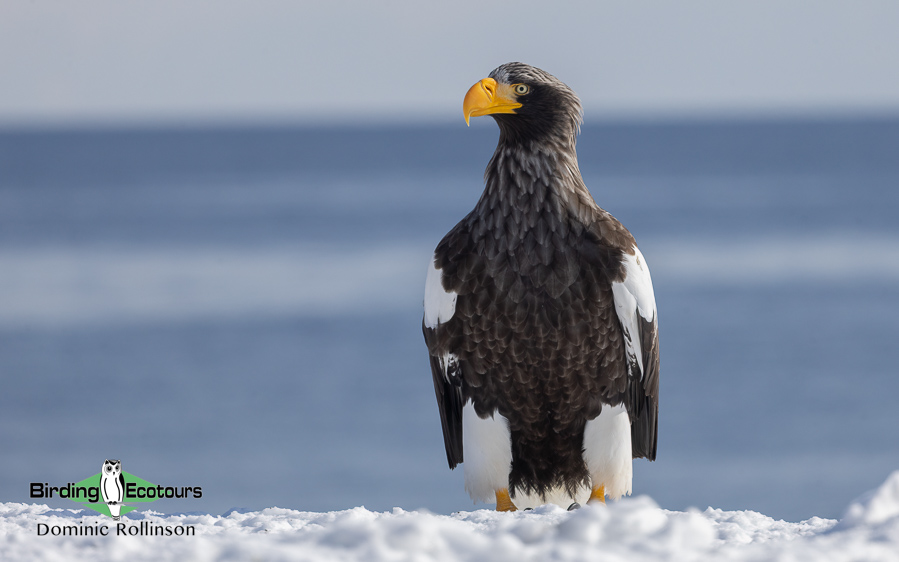 Steller’s Sea Eagle is one of the many spectacular highlights of this Japanese winter birding tour.
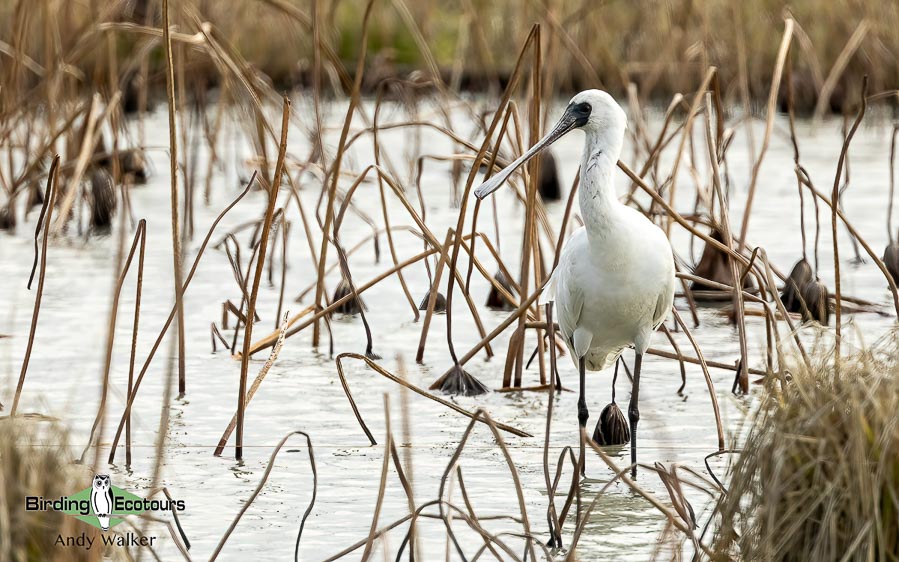
This Japanese winter birding tour is designed around the spectacular gatherings of cranes and sea eagles which make Japan their winter home, as well as a range of Japanese endemic birds on offer. The first leg of this Japan bird tour will be around the island of Kyushu, this will be the furthest southwest we venture, and here we will search for the localized Japanese Murrelet and the wintering hordes of Hooded Cranes and White-naped Cranes, with an accompanying cast of other winter visitors, which may include tough world birds like Black-faced Spoonbill and Saunders’s Gull.
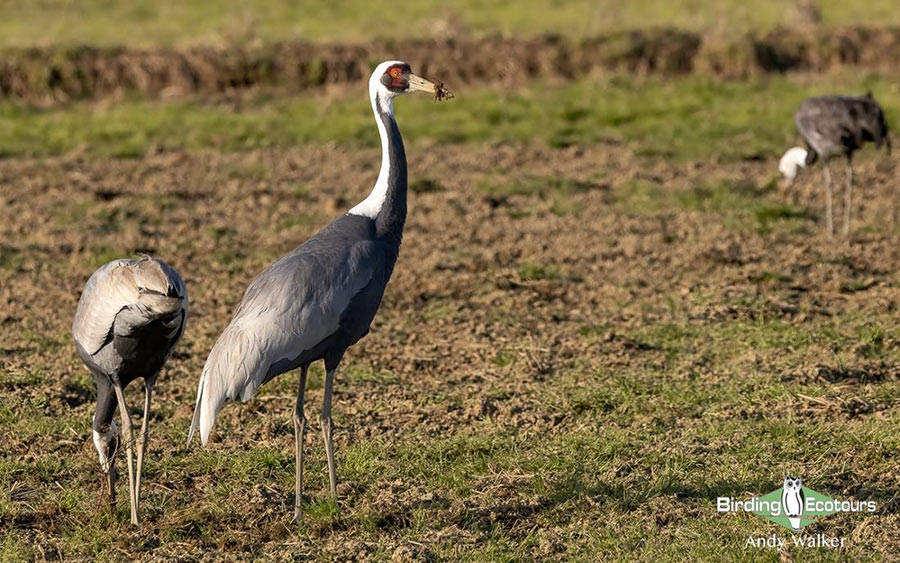 White-naped Crane will be enjoyed on our Japan birding tour.
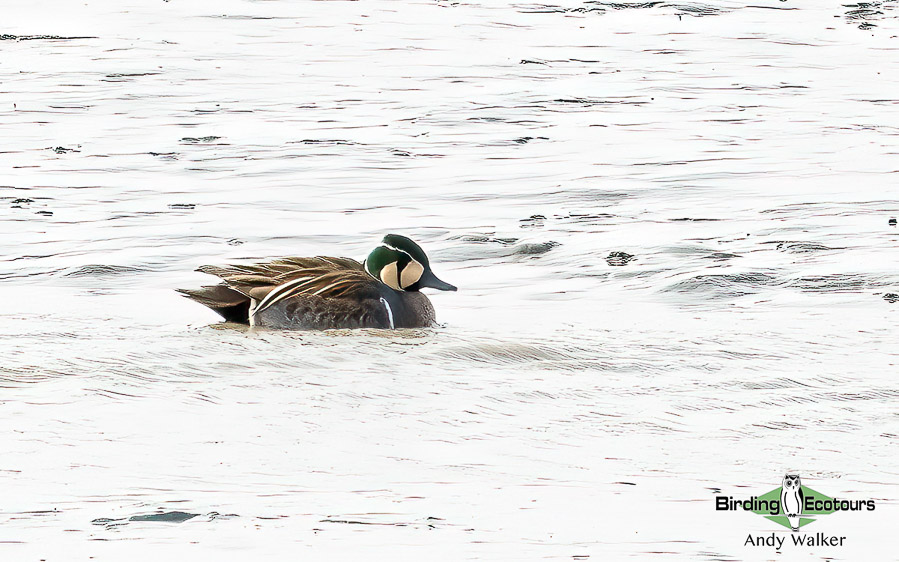
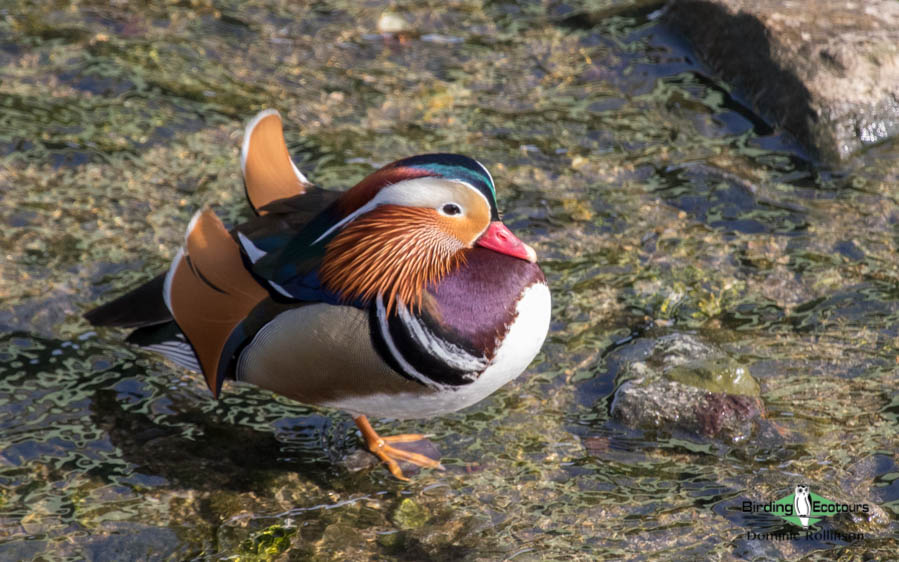
The second leg of this Japanese birding trip will be on and around the island of Honshu, home to Tokyo. We will meander through the forests, hills, and lakes of central Honshu to seek out specials such as Green Pheasant, Japanese Pygmy Woodpecker, Japanese Green Woodpecker, Varied Tit, and perhaps, if we are lucky, the shy and endemic Copper Pheasant. We include visits to lakes to look for Baikal Teal and Mandarin Duck, and to a valley where endemic Japanese Macaque and Japanese Serow (a goat-antelope) make their winter home.
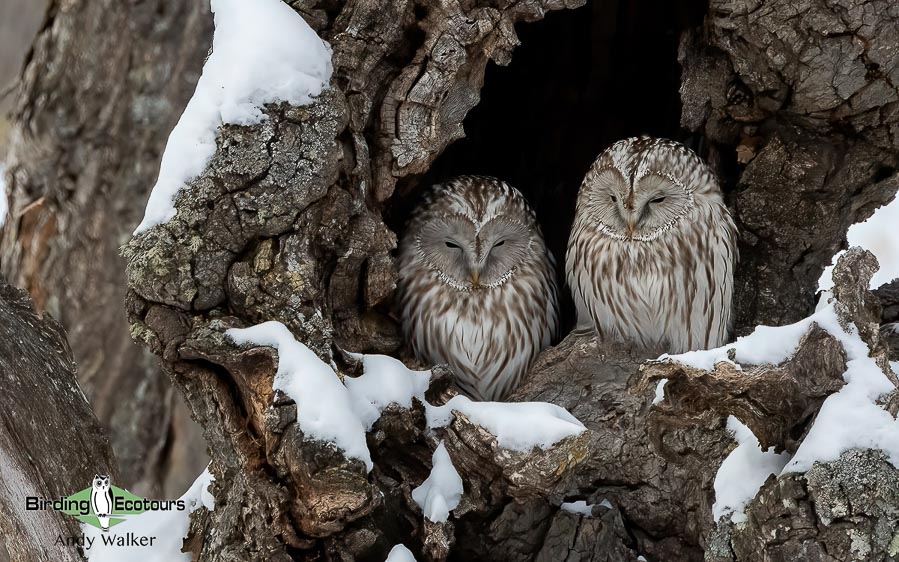
The final leg of this bird tour in Japan will be to the winter wonderland of Hokkaido, this will be the furthest northeast we go. Here, in a landscape dominated by dramatic volcanoes, calderas, coastal plains, and rugged peninsulas, species numbers are low, but quality is extremely high! We visit the feeding and roosting grounds of Red-crowned Cranes, seeing them at close range where they are easily photographed, perhaps with a White-tailed Eagle overhead. We see flocks of wintering Whooper Swans and other waterfowl, look for Crested Kingfisher, seek out winter roosts of Ural Owl, and visit a feeding site of the rare and Endangered (BirdLife International) Blakiston’s Fish Owl. During our time on the Shiretoko and Nemuro Peninsulas we spend time watching arguably the world’s largest and most spectacular raptor – Steller’s Sea Eagle. Coastal sea-watching and offshore boat trips will allow us to search for an array of exciting wintering seabirds, including sea ducks, loons (divers), grebes, and an assortment of alcids.
We also offer a short three-day extension to this tour which will visit Miyake-Jima (Miyake Island), a volcanic island in the Izu Archipelago, located approximately 110 miles (180 kilometers) southeast of Tokyo. This trip will make use of a ferry crossing, with a morning spent on the island looking for the specials. The purpose of this trip is to look for Izu Thrush, Owston’s Tit, and Izu Robin on the island, as well as Black-footed Albatross, Laysan Albatross, Short-tailed Albatross, and Tristram’s Storm Petrel out at sea.
Please note, depending on availability of services (and other factors beyond our control) we may have to switch the ordering of the three islands/legs of this trip. We will, however, ensure we spend the same number of nights as described below, and target the same species.
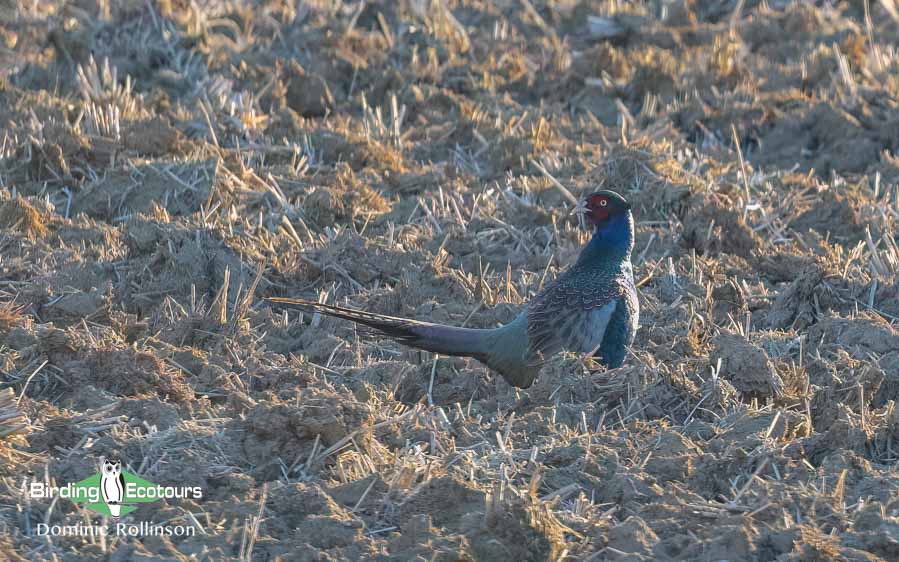 Green Pheasant, one of several Japanese endemics we will be looking for on this tour.
Itinerary (14 days/13 nights)
Day 1. Arrival in Kirishima
After your afternoon arrival at Kagoshima Airport on the southern island of Kyushu, you will be met at the airport and transferred to a hotel in the nearby town of Kirishima. Good birding can be had walking along the river just below the hotel, with Black-tailed and Vega Gulls, Japanese Bush Warbler, Japanese Wagtail, Brown-eared Bulbul, White-cheeked Starling, and even the Endangered (BirdLife International) Black-faced Spoonbill, all possible. Depending on arrival times, we may have time for birding in the Kagoshima Prefectural Forest where we may be lucky enough to find the rare Copper Pheasant. We will then meet for a group welcome dinner in the evening.
Overnight: Kirishima
Days 2 – 3. Kirishima to Izumi (Arasaki)
We will depart from Kirishima and travel north for approximately three hours to the city of Yatsushiro, located in the Kumamoto Prefecture. The coastal areas here will be searched for the globally range-restricted Saunders’s Gull as well as an assortment of shorebirds and waterbirds. We will then make our way back south to Izumi, our base for the next two nights.
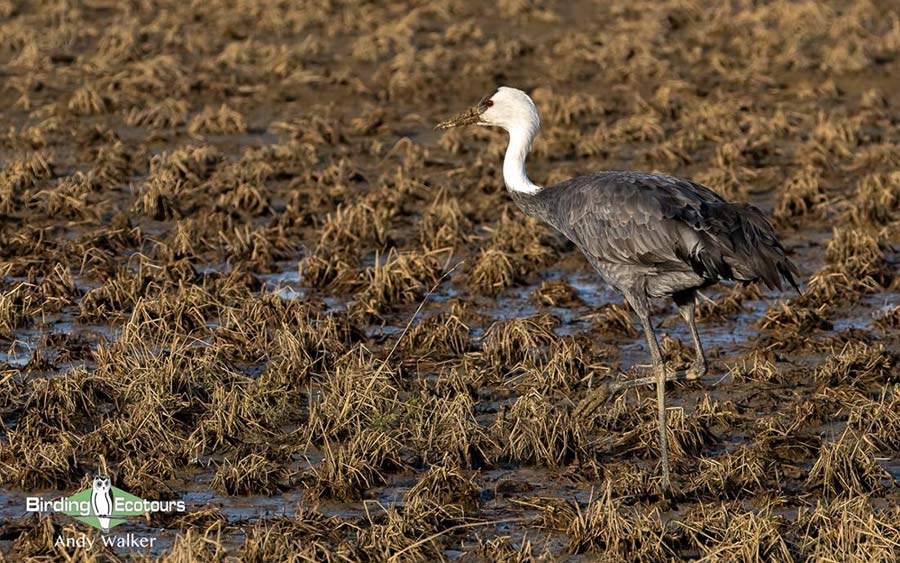 The striking Hooded Crane will be enjoyed in huge numbers around Izumi.
Izumi is home to the famed Izumi Crane Observation Centre, and this is one of the main reasons for our visit to the area and we will spend some time birding from the observation tower. This part of Japan is famous worldwide for its winter flock of almost 15,000 cranes! Most of the flock is made up of Hooded Cranes, with White-naped Cranes being the next most abundant. Annually the flock also occasionally holds low numbers of Common Crane and Sandhill Crane, or even the exceptionally rare and Critically Endangered (BirdLife International) Siberian Crane, so we will carefully scan through the vast flocks to see what may be lurking among the masses!
There is plenty besides the cranes to look out for in the area. Wildfowl here might include Common Shelduck, Northern Shoveler, Falcated Duck, Eurasian Wigeon, Eastern Spot-billed Duck, Northern Pintail, Common Pochard, Tufted Duck, and Greater Scaup. While shorebirds here could include Northern Lapwing, Kentish Plover, Long-billed Plover, Little Ringed Plover, Dunlin, Common Snipe, and an assortment of stints and sandpipers. Gulls could include Black-tailed Gull, Vega Gull, and Slaty-backed Gull. Large wading birds might include Eurasian Spoonbill and Black-faced Spoonbill. Raptors in the area could include Osprey, Hen Harrier, Black Kite, Eastern Buzzard, Common Kestrel, Merlin, and Peregrine Falcon.
We often see interesting passerines in the area too, such as Bull-headed Shrike, (Eastern) Rook, Daurian Jackdaw, Varied Tit, Chinese Penduline Tit, Eurasian Skylark, Zitting Cisticola, Asian House Martin, Russet Sparrow, Red-flanked Bluetail, Pale Thrush, Red-throated Pipit, Siberian Pipit, and several bunting species, including Yellow-throated Bunting, Meadow Bunting, and Common Reed Bunting.
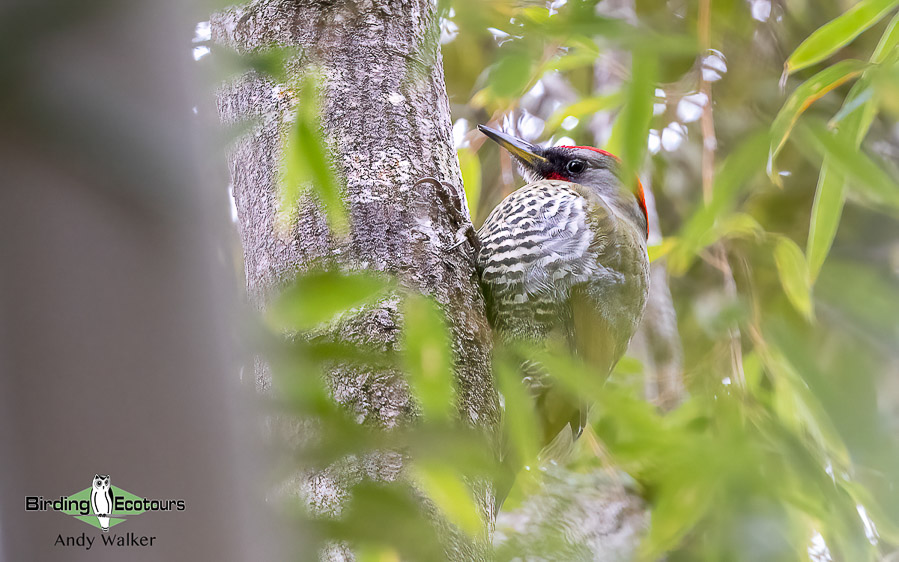 The endemic Japanese Green Woodpecker can be seen around Kogawa Reservoir.
During the day here we will visit Kogawa Reservoir (Kogawa Dam) just outside of the city. The reservoir is great for waterbirds and the nearby river holds an interesting range of species too. Woodland surrounding the reservoir is mixed and features evergreen broadleaf trees and bamboo. An interesting range of birds are possible on the reservoir here, including Mandarin Duck, Baikal Teal, Falcated Duck, Eurasian Wigeon, Eastern Spot-billed Duck, Eurasian Teal, Common Pochard, Tufted Duck, and Greater Scaup.
Other possibilities in the area could include White-bellied Green Pigeon, Long-billed Plover, Common Sandpiper, Green Sandpiper, Eurasian Sparrowhawk, Eurasian Goshawk, Common Kingfisher, Crested Kingfisher, Japanese Green Woodpecker, White-backed Woodpecker, Brown Dipper, Ryukyu Minivet, Warbling White-eye, Red-flanked Bluetail, Daurian Redstart, Blue Rock Thrush, Japanese Wagtail, Yellow-throated Bunting, and the tricky Grey Bunting. The unobtrusive and rare Copper Pheasant will also be searched for in these woodlands.
Overnight (two nights): Izumi
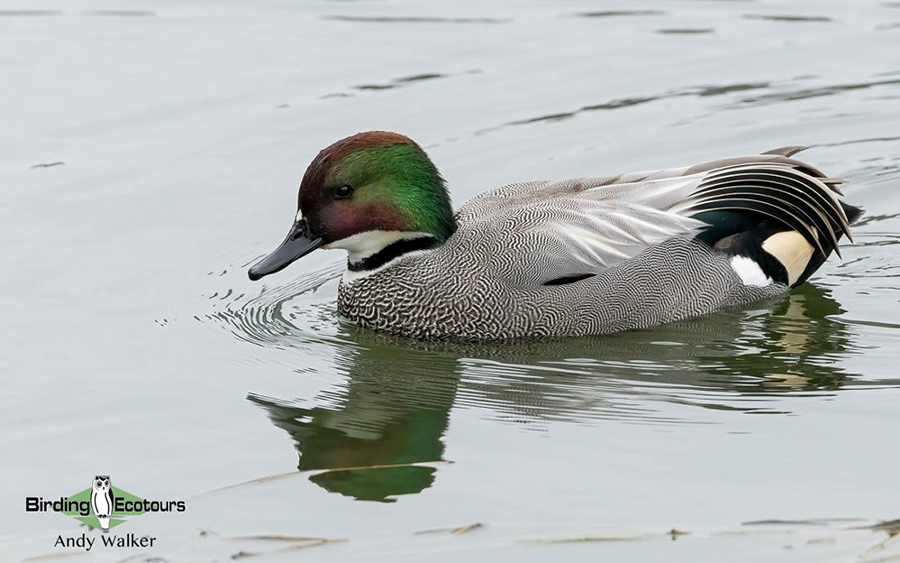 The rather spectacular Falcated Duck can be found at several sites we will visit while birding in Japan.
Day 4. Izumi to Hyuga
We will travel from Izumi to Hyuga City, likely birding a couple sites along the way, perhaps searching some beech forests, where with luck, Copper Pheasant can occasionally be found.
On arrival in the Hyuga area we have a range of sites to check, depending on what we are still targeting after the previous few days birding, such as Cape Hyuga, Hyuga Port, Kadogawa Harbor, and Tomi Peninsula. One of the main target species in this area is Japanese Murrelet. They breed nearby on Birojima Islet during the summer, an Important Bird Area (IBA) (BirdLife International) and can often be observed from the areas we will visit during our time here. Their numbers increase in the late winter and early spring as they return to the area to prepare for the onset of the breeding season.
Other species we will look for in the area include Chinese Bamboo Partridge, Japanese Wood Pigeon, Japanese Cormorant, Japanese Green Woodpecker, Japanese Bush Warbler, Ryukyu Minivet, Warbling White-eye, Red-billed Leiothrix, and Daurian Redstart.
Overnight: Hyuga
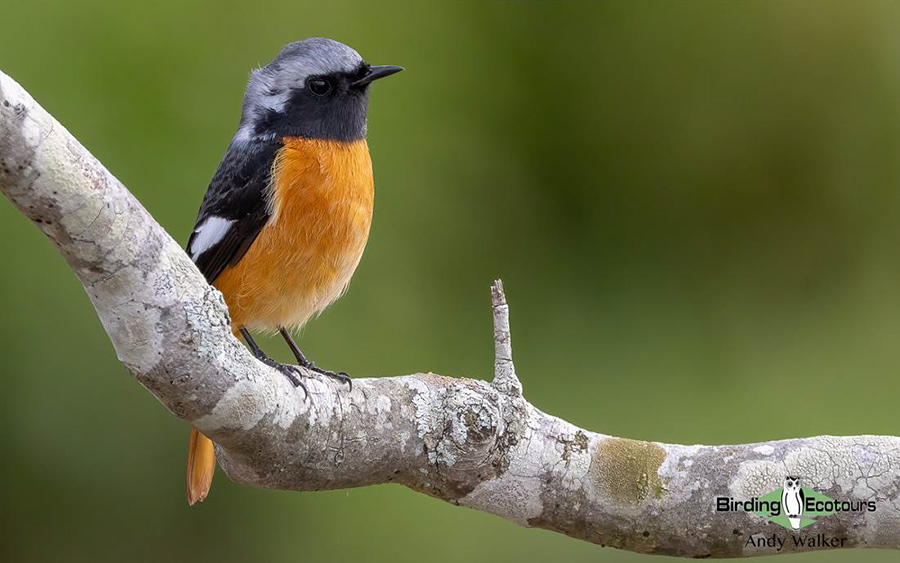 Daurian Redstart adds a splash of color to the Japanese woodlands.
Day 5. Travel from Hyuga to Miyazaki, flight to Tokyo
We will leave Hyuga and drive back to Miyazaki (perhaps having another look for Japanese Wood Pigeon, if still missing), where we will connect with a flight to Tokyo.
On arrival in Tokyo, we will drive to Chiba Prefecture where we will spend the night. Depending on arrival times, we may have time to bird Lake Inbanuma where we may find Eastern Marsh Harrier, Smew, Brown-headed Thrush, and massive flocks of Baikal Teal.
Overnight: Narita
Day 6. Chiba to Karuizawa
This morning we will head out to some great wetland areas close to Narita. Here we can look for species hard to find elsewhere on the tour, including Eastern Marsh Harrier, Tundra Swan, and Brown-headed Thrush. Lakes in the area often have large flocks of the stunning Baikal Teal which are sure to impress, and we might also see Falcated Duck and Eastern Spot-billed Duck. We will look through the buntings including Meadow Bunting, Common Reed Bunting, Rustic Bunting and Masked Bunting, in the hope of finding the tricky Ochre-rumped Bunting.
Next, we will head towards the town of Karuizawa in Nagano Prefecture, our base for the next couple of nights. Along the way we will make some stops, including at a regular site for Mountain Hawk-Eagle. Nearby, we will drive some hilly, forested roads to look for Japanese Accentor and other forest species.
At Karuizawa, over the next couple of days, we will visit the Karuizawa Wild Bird Sanctuary (Karuizawa Yacho no Mori). The sanctuary was established in 1974 and is an area of mixed woodland including beautiful Japanese chestnut and larch trees. The sanctuary is covered by a network of paths that provide great access to this excellent and “birdy” forest. We will enjoy a range of exciting birds here during our birding sessions, and some of the highlights could include Copper Pheasant, Japanese Pygmy Woodpecker, Great Spotted Woodpecker, White-backed Woodpecker, Japanese Green Woodpecker, Varied Tit, Willow Tit, Coal Tit, Long-tailed Tit, Eurasian Nuthatch, Eurasian Treecreeper, Eurasian Wren, Brown Dipper, Eurasian Jay, Dusky Thrush, Daurian Redstart, Chinese Hwamei, Goldcrest, Japanese Wagtail, Japanese Grosbeak, Rustic Bunting, Yellow-throated Bunting, Brambling, and Siberian Long-tailed Rosefinch.
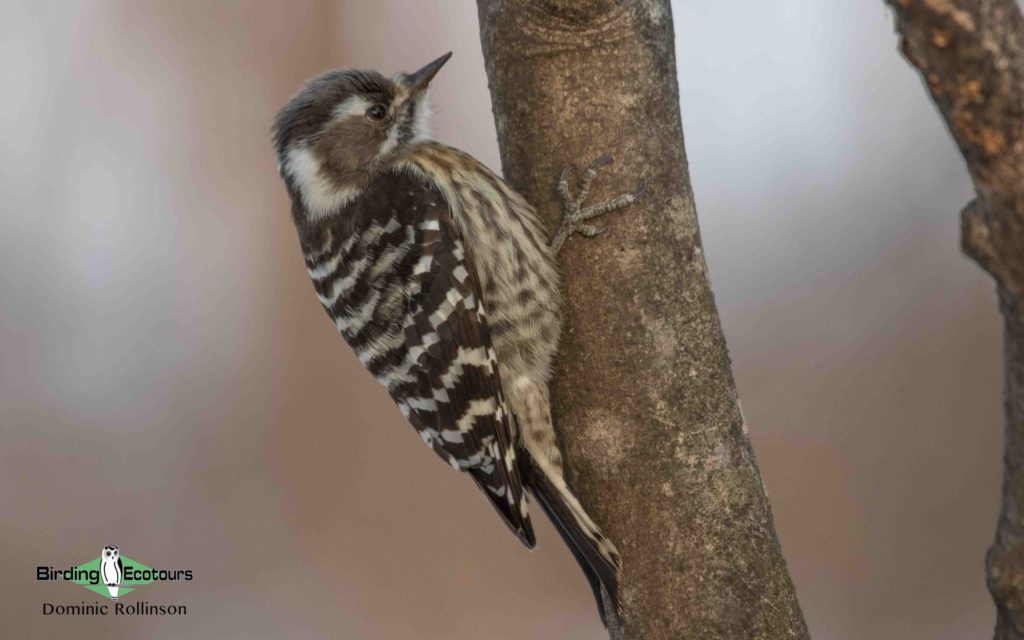 Japanese Pygmy Woodpecker is rather widespread throughout Japan.
We will keep an eye on recent bird reports for any sightings of the irruptive and tricky-to-target Japanese Waxwing and Bohemian Waxwing during our time in Karuizawa.
Open farming areas will be birded for the Japanese endemic Green Pheasant, which can sometimes show well. Here we will also search for a variety of thrushes, buntings and finches.
Overnight: Karuizawa
Day 7. Karuizawa and snow monkeys
We will visit the famous snow monkeys at Jigokudani Yaen Koen (Monkey Park), here we can watch the endemic Japanese Macaques frolic in the snow and soak in the hot springs. We will also be looking here for Japanese Serow (a goat-antelope).
While the focus at the site will be on the amazing spectacle of the monkeys, we should also keep our eyes peeled for a range of birds that might be moving through the area, such as Golden Eagle, Eurasian Jay, Varied Tit, Willow Tit, Goldcrest, Brown Dipper, Alpine Accentor, Japanese Accentor, and Eurasian Siskin. Nearby ponds can hold Baikal Teal, Japanese Wagtail, and Long-billed Plover, so we will check those out as needed. After finishing up with the monkeys and birds around Jigokudani Yaen Koen, we will head back to Karuizawa to look for more of the birds mentioned in Day 6.
Overnight: Karuizawa
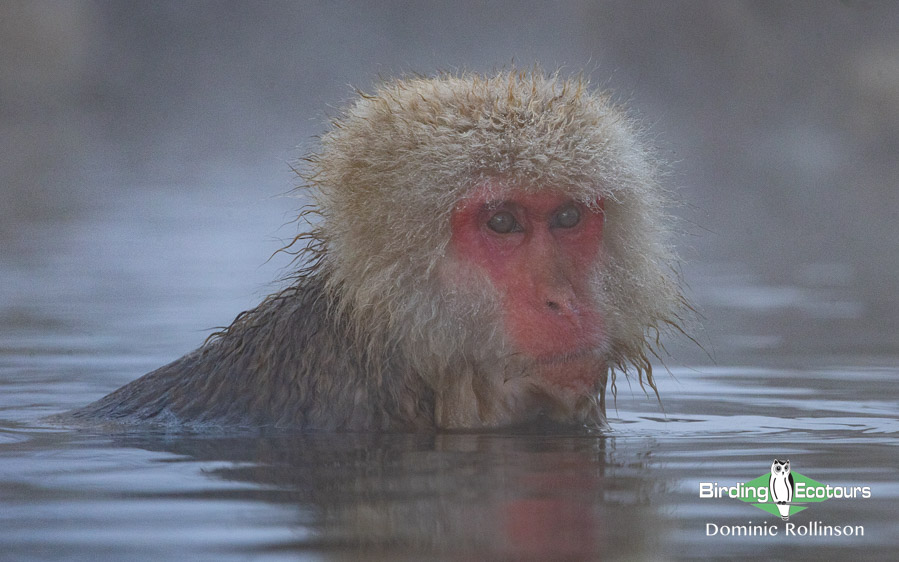 We will enjoy spending time with Japanese Macaques as they bathe in the hot springs of Jigokudani.
Day 8. Karuizawa to Tokyo, flight to Kushiro, Hokkaido, and transfer to Tsurui
We will spend the some of the morning around Karuizawa looking for the birds mentioned above, before heading back to Tokyo. From Tokyo, we will catch our flight to Kushiro on the incredible island of Hokkaido. We will arrive in the evening and head to our hotel for the night.
Overnight: Tsurui
Day 9. Tsurui to Yoroushi
This morning we will visit Tsurui-Ito Tancho Sanctuary, the world famous Red-crowned Crane site, and what a spectacular sight they are! Though the cranes will be the main targets here, there are a few other interesting birds to look out for in the local area, such as Whooper Swan, Common Crane, Ural Owl (with luck we might find a roosting bird), White-tailed Eagle, Crested Kingfisher, Marsh Tit, Willow Tit, Eurasian Nuthatch, Oriental Greenfinch, (Common) Redpoll, Asian Rosy Finch and the irruptive and unpredictable Bohemian Waxwing. We will also hope to see Japanese Wagtail. Today we could also see the magnificent Steller’s Sea Eagle for the first time on the tour, certain to be a tour highlight.
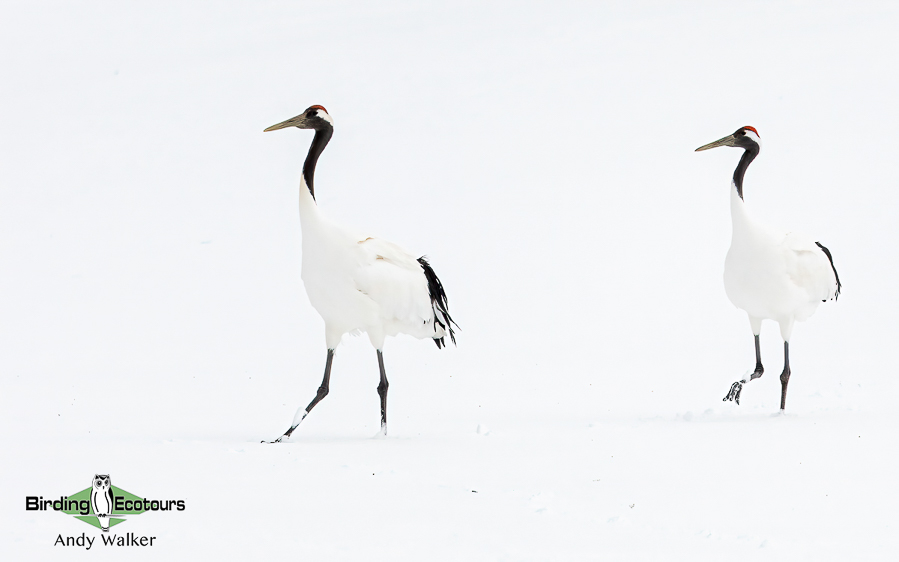 Red-crowned Crane, one of the most elegant birds to be enjoyed while birding in Hokkaido, surely one of the most graceful birds in the world too?
As we travel north from Tsurui towards the Yoroushi area (our base for the next couple of nights), we will pass by Lake Kussharo and Lake Mashū and we will look out along the way for the ginormous duo of both Steller’s Sea Eagle and White-tailed Eagle. Here, we will likely enjoy good looks at Whooper Swans on the lake and bird the woodlands for Black Woodpecker and an assortment of finches.
In the evening, we will try to find another one of our big tour targets, the huge and Endangered (BirdLife International) Blakiston’s Fish Owl. They inhabit mature boreal forest close to rivers and streams within which they forage, mainly on fish, occasionally in the ponds outside our lodging (but it can be a very long nocturnal wait). There is also often a Solitary Snipe in the area too.
Overnight: Yoroushi
Day 10. Yoroushi / Rausu (Shiretoko Peninsula)
We have a full day birding the fascinating Shiretoko Peninsula and nearby area, and it promises to be an exciting experience. We will take a boat cruise for a couple of hours along the picturesque Rausu Coast and within the Nemuro Strait (it is really magnificent scenery). During the winter, drift ice is usually present, this ice brings with it plankton which in turn attracts fish, which further attracts a range of amazing birds (and whales later in the year). During the winter, the area becomes the best place in the world for observing the magnificent Steller’s Sea Eagle, one of the main targets of the day.
This trip could well be one of the tour highlights (and that is quite something, given what we will have already experienced!). Along with excellent looks at the sea eagles, we could find other exciting species like White-tailed Eagle, Harlequin Duck, Long-tailed Duck, Common Goldeneye, Common Murre (Common Guillemot), Spectacled Guillemot, Black-tailed Gull, Slaty-backed Gull, Glaucous Gull, Glaucous-winged Gull, Common (Kamchatka) Gull, Red-throated Loon (Red-throated Diver), Black-throated Loon (Black-throated Diver), Pacific Loon (Pacific Diver), Pelagic Cormorant, and Japanese Cormorant.
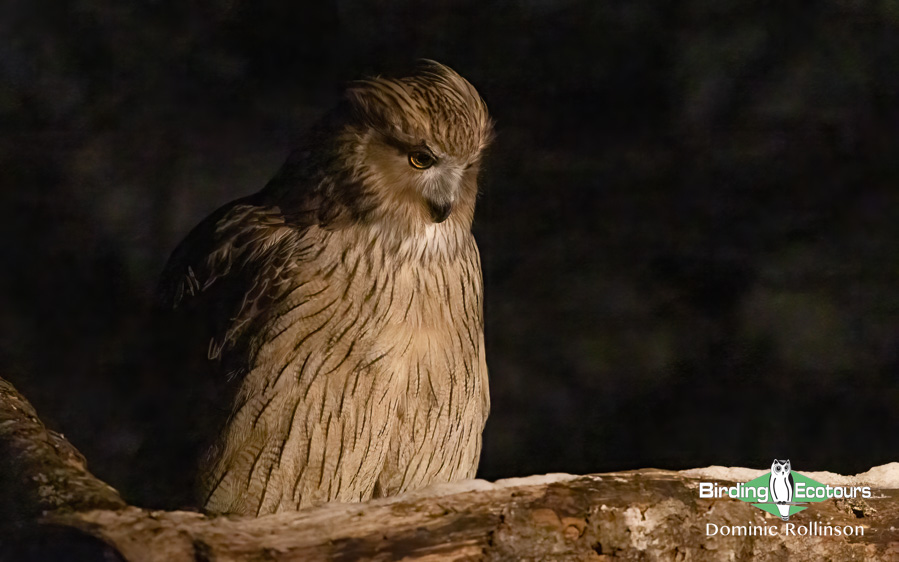 Blakiston’s Fish Owl is one of the special targets on this tour.
We will also spend time birding from land, and will visit the excellent Notsuke Peninsula, where we will call in to the Notsuke Peninsula Nature Center. Here we are likely to see several species already enjoyed during the morning or earlier in the tour, but others may include (Black) Brant Goose, Harlequin Duck, Stejneger’s Scoter, Black Scoter, Smew, several alcids, gulls, loons (divers), and cormorants, Steller’s Sea Eagle, Asian Rosy Finch, and Snow Bunting. If conditions are right, we could get sightings of migrating alcids from land, with Common Murre (Common Guillemot), Thick-billed Murre (Brünnich’s Guillemot), Spectacled Guillemot, Pigeon Guillemot, Least Auklet, and Crested Auklet all possible.
In the evening we will again try for Blakiston’s Fish Owl at our accommodation, where we hope again to get good views of this mega bird.
Overnight: Yoroushi
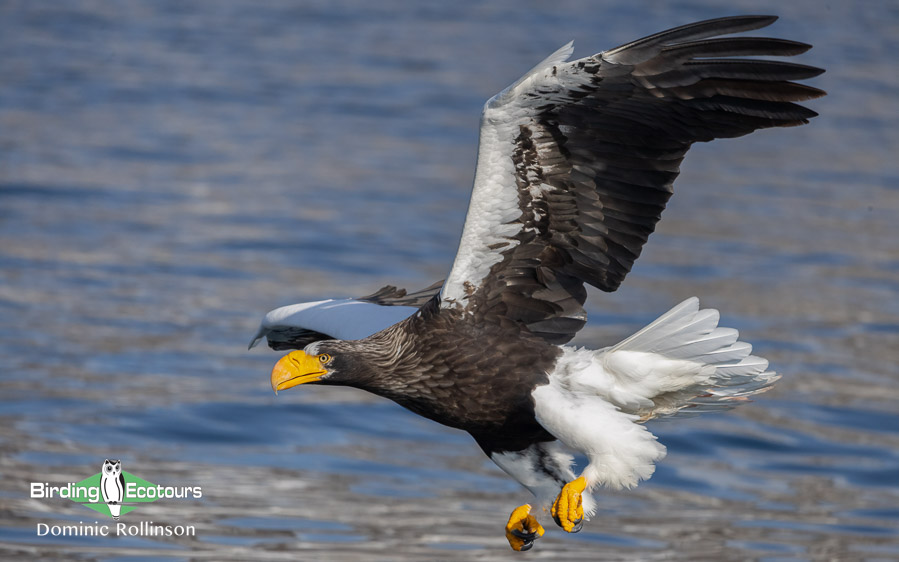 The list of spectacular birds in Japan is long and Steller’s Sea Eagle is normally right at the top of this list.
Days 11 – 12. Yoroushi to Nemuro
On one of the mornings (weather dependent) we will head to Nemuro on the scenically spectacular Nemuro Peninsula jutting out into the Okhotsk Sea, another excellent birding area. If weather conditions allow, we will take an exciting boat trip from Habomai Harbor, where we may again see a range of most-wanted sea ducks, grebes, loons (divers), gulls, and alcids. Possibilities in the harbor and on the boat trip include Harlequin Duck, Stejneger’s Scoter, Black Scoter, Long-tailed Duck, Red-breasted Merganser, Red-necked Grebe, Pigeon Guillemot, Spectacled Guillemot, Least Auklet, Crested Auklet, Slaty-backed Gull, Glaucous-winged Gull, Pacific Loon (Pacific Diver), Red-faced Cormorant, and Pelagic Cormorant.
Over these two days we will also spend time birding on land around the Nemuro Peninsula looking for a range of birds, including the rare Rock Sandpiper, Common (Kamchatka) Gull, Red-faced Cormorant, White-tailed Eagle, Steller’s Sea Eagle, Rough-legged Buzzard, Lapland Longspur (Lapland Bunting), and the elusive Asian Rosy Finch. Additional sites that we will likely check during the day (and potentially the following morning) include Lake Furen, Nemuro Harbor, and the Shunkunitai Wild Bird Sanctuary, it is another great birding area.
Overnight: Nemuro
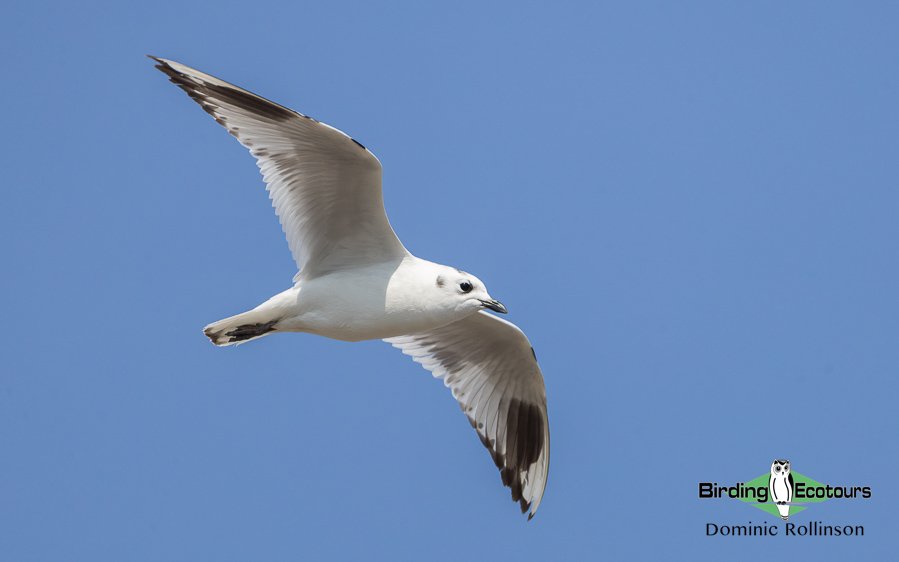 Gulls abound in Japan, such as this Saunders’s Gull.
Day 13. Nemuro to Kushiro and flight to Tokyo
We will have some additional time in the Nemuro area before gradually make our way back to Kushiro and catching our flight back to Tokyo.
Overnight: Tokyo
Day 14. Departure from Tokyo
We don’t have any birding scheduled this morning and you can catch your international flights from Tokyo, with the Tokyo’s Haneda International Airport being the closest airport to our hotel.
If you are joining our short, three-day Miyake-Jima trip to look for pelagic birds and the Miyake-Jima specials, you can spend the day at your leisure. You could perhaps go birding at some of Tokyo’s many fantastic birding sites, such as Ueno Park, Kasai Rinkai Park, Tokyo Port Wild Bird Park/Oi Bird Park, Funabashi Seaside Park, take in some of Tokyo’s many cultural highlights, (Meiji Jingu Shrine) and shrines, or perhaps just enjoy spending the day in this fast-paced and modern mega city.
Please note that the itinerary cannot be guaranteed as it is only a rough guide and can be changed (usually only slightly) due to factors such as availability of accommodation, updated information on the state of accommodation, roads, or birding sites, the discretion of the guides and other factors. In addition, we sometimes must use a different guide from the one advertised due to tour scheduling and other factors.
Map
Testimonials
Gallery
General Information
Japan Birding Tour: Spectacular Winter Birds
General Information
Featuring a long list of highly desirable species, including some of the most spectacular birds in the world, our winter Japan birding tour visits three of the five main islands that make up this huge archipelagic country. We will go birding in Hokkaido, Kyushu, and Honshu on this Japanese winter birdwatching tour and we will also take a ferry ride to the small endemic-filled island, Miyake-Jima, looking for albatrosses along the way. Our Japan bird tour will also offer an insight into the fascinating cultural history of Japan, which is unlike anywhere else in the world.
Some of the many exciting birds we look for on our Japanese winter bird tour include Red-crowned Crane, Hooded Crane, White-naped Crane, (with luck possibly even the Critically Endangered (BirdLife International) Siberian Crane), Black-faced Spoonbill, Baikal Teal, Falcated Duck, Steller’s Sea Eagle, White-tailed Eagle, Blakiston’s Fish Owl, Ural Owl, Saunders’s Gull, Black-tailed Gull, Japanese Murrelet, Laysan Albatross, Short-tailed Albatross, Black-footed Albatross, Copper Pheasant, Japanese Green Woodpecker, Izu Thrush, Owston’s Tit, Varied Tit, Izu Robin, and Asian Rosy Finch.
Our tour starts in the southern city of Kagoshima on the island of Kyushu and ends in Tokyo near Haneda Airport on Honshu Island. We recommend you book international flights into Kagoshima and out of Haneda for this tour.
Please note we can offer custom bird tours in Japan at other times of the year to target summer breeding species, for example, that visit Japan and are tricky to see on their wintering grounds. Targets can include Japanese Robin, Japanese Thrush, Narcissus Flycatcher, Japanese Leaf Warbler, Ijima’s Leaf Warbler, Sakhalin Leaf Warbler, Marsh Grassbird, Oriental Stork, Pleske’s Grasshopper Warbler, Sakhalin Grasshopper Warbler, Middendorf’s Grasshopper Warbler, and Yellow Bunting. Please email us if you are interested in looking for these exciting species on a custom Japanese birding tour.
ITINERARY AND SPECIES RECORDING (BIRD LISTS AND ANIMAL LISTS)
Ahead of our Japan birdwatching tour we will send you a detailed daily itinerary (along with arrival instructions). We will then provide you with a printed copy of the itinerary on the first day of the tour.
The printed copy of the itinerary will include a bird list and list of other animals possible on the tour and we will go through this each night (but it is totally optional whether you join or not – though it is considered extremely useful). We always use the latest version of the International Ornithological Congress (IOC) taxonomy for our bird list and for all other wildlife, we use the International Union for Conservation of Nature (IUCN) taxonomy. While birding during the tour we will create eBird checklists and these will be shared with any participants who wish to have a copy. Just provide us with your eBird user details at the beginning of the tour for us to do this.
Each evening, we will go through the itinerary to give you any specific information to be aware of for the following day (like what clothes and equipment will be needed, when we will be having breakfast, departure time from the hotel, and any important birds we will be looking for, etc.).
After the completion of the tour, we will email you a PDF copy of an illustrated trip report. This will include a complete IOC and IUCN checklist of all wildlife recorded during the tour. Any interesting bird, animal, or landscape photographs will be included in the trip report and will also be added to our tour-specific Flickr pages as a reminder, and you are able to download these for free and share with your friends and family.
DAILY ACTIVITIES, PHYSICAL REQUIREMENTS, AND TOUR PACE
This Japanese birdwatching tour is not considered too physically demanding (though coldness in the north can increase tiredness and care should be taken at all times due to the potential for snow or ice). We will spend the majority of the time birding on easy to moderate trails and roadsides at a range of elevations and will experience cool conditions throughout, with potentially warmer conditions in the south and cooler (including very cold) temperatures in the north. Given the high likelihood of snow and ice in mountainous areas of Honshu and while on Hokkaido, extreme caution should be taken when walking, with slips and falls a serious risk. We recommend items to bring in the “What to Bring” sections of this document, below, which may reduce your risk of slips, trips, and falls.
On this tour we will try to use as much daylight time as possible and be out from dawn-to-dusk. Approximate sunrise and sunset times when we run our tour are Kyushu (06:45-18:15 hrs.), Hokkaido (06:00-17:00 hrs.), and Honshu (06:10-17:30 hrs.). Our birding start time will sometimes be dependent on breakfast timings at the hotel, but we will mostly have breakfast before heading out for our birding.
This is a birding-focused tour that does offer some good incidental photo opportunities, though these are secondary to the actual birding element of the tour, i.e. seeing the many endemic species and subspecies of the country as well as other overwintering specialties, will be considered the priority. That said, some good photo opportunities are available at many of the sites we will be visiting.
Some days we will have domestic flights, but the majority of these are short with a relatively short check in time. Most drives on the tour are relatively short and some may be around the three to four hour mark, but will likely include birding stops. Please note that on longer drives our driver may occasionally need to take a short break for safety. This will generally be done at a place where there is some birding or other activity available (such as lunch). Everyone’s safety is our concern on this and all of our tours. More details on transportation and domestic flights are provided in the relevant sections below.
Note that on this tour we stay for two nights at a lodge in Yoroushi on Hokkaido, where we have two opportunities to observe the Endangered (BirdLife International) Blakiston’s Fish Owl. This will require sitting and waiting in a heated lounge area watching a section of lighted river where, with luck, an owl may drop in. Sometimes the owl will come in the early evening, at other times it might be just before dawn, or at other times it could be in the middle of the night. So in order to see this bird it might require a very late night or a very early morning birding session. The lodge maintains a logbook of sightings, which might give us a clue on recent timings, which can prove useful, but it’s worth been prepared for a long night. But at least the lounge is very comfortable and we’re not sitting in the freezing outdoors. Note that your driver/guide is unlikely to sit up all night as s/he will be required to be fully rested in order to safely drive and guide you the following day. But don’t worry, if the owl comes in, it will be close and is the size of a Great Dane, so it is tough to miss, this is the largest owl in the world with an enormous wingspan!
PASSPORT, VISA, AND LOCAL LAWS
To visit Japan, most visitors will require a visa and are granted a free three months (90 days) visa on arrival. Please refer to your own government information for additional details on entry requirements which may vary slightly depending on your nationality. It is likely that you will have to show proof of onward travel on arrival in Japan and may need to provide an address for your stay (we will provide this information to you in the arrival instructions). Some airlines will not let you check in and board a plane to Japan without first seeing that you have an onward ticket to leave at the end of your visit. Please make sure that you have all the necessary documents required and please contact us if you have any questions.
Your passport should be valid for the duration of your stay. You must always carry your passport with you. The police can arrest you if you cannot show proof of your visa status.
Japan has some very strict customs rules regarding what can and cannot be taken in or out of the country, please read the full details here. It is highly unlikely anyone would bring these items on a birding tour, however it’s useful to be fully aware of the regulations. Note that it is illegal to bring meat products, including sausages, bacon, and ham, to Japan without permission from the Japanese Animal Quarantine Service (penalties are severe and can include fines and prison sentences. Be aware that some products may be available in Japan (such as whale meat) but taking it to your home country could result in fines or prison sentences on arrival there.
For ease of entry, you should register your visit on the Visit Japan website here, you will get a QR code to make your arrival experience smoother. You can save this QR code on your phone to present when requested or you can print it out and bring a hard copy with you. Note that if you are unable to access the website (or if the website goes down), you can either complete the information on your phone in the arrivals area (which can be a little tricky), or you can fill in a paper version with the data required at the baggage claim hall (location may vary depending on arrival airport).
Please make sure that you bring a photocopy of your passport with you on the tour, this can be kept with other important documents like vaccination certificates, emergency contact details, and insurance documents.
Smoking is illegal on the streets of Tokyo and some other cities. Smoke only in designated areas (if you are a smoker please refer to the Birding Ecotours guidance on smoking here). It is illegal to carry some common prescription or over-the-counter medicines under Japan’s strictly-enforced law on anti-stimulant drugs, such as Vicks inhalers, medicines for allergies and sinus problems, cold and flu medication containing pseudoephedrine and some painkillers containing codeine. Ignorance of the law does not count as a defense.
Most Japanese people are welcoming and friendly but can be reserved. Loud, boisterous behavior may receive negative attention. Showing affection in public is less common than in the UK and US.
Tattoos have a historical association with organized crime in Japan. While acceptance is increasing, some public facilities do not admit people with tattoos – for example, public swimming pools, hot springs, beaches and some gyms. Other establishments request you cover tattoos while using the facilities.
Please be aware that in Japan it is illegal to carry a knife with a blade 2.3 inches / 6 centimeters or longer, and this can include items that many birders take on tours without a second thought, such as a Swiss Army knife or a Leatherman multi-tool device. Penalties can include jail time or fines.
LOCAL CUSTOMS AND ETIQUETTE
Please refer to the specific local customs and etiquette document that we will email you ahead of the tour.
TRAVEL INSURANCE
As mentioned in our standard Terms and Conditions, we strongly encourage you to purchase comprehensive trip cancellation insurance to protect against unexpected events that might cause delays and interruptions to travel. It is important that the insurance covers illness, medical issues, accidents, repatriation, loss of luggage or any valuable items that you might be bringing (e.g. optical and camera equipment) etc.
HEALTH AND PESTS
We rate our Japanese bird tours as one of the easier destinations to visit from a health point of view, though we do recommend you consult your doctor or local travel clinic regarding vaccine requirements before your bird tour to Japan. We recommend doing this around two months prior to the tour start date so that any required vaccine courses can be completed in time for your departure.
There is no risk of Yellow Fever in Japan and there is not currently (August 2024) any certificate requirement for anyone arriving from countries with a risk of Yellow Fever transmission. Please refer to the World Health Organization’s list of countries where Yellow Fever transmission is possible, here.
Everyone visiting Japan should be up to date with standard vaccinations and boosters, like Diphtheria-Tetanus-Pertussis, Chickenpox (Varicella), Flu, Covid-19, Polio, Shingles, and Measles-Mumps-Rubella (MMR). Other vaccinations that might be required (depending on your personal situation, and to be confirmed by your travel clinic/doctor), include Hepatitis A, Hepatitis B, Japanese Encephalitis, Tick-borne Encephalitis, Cholera, Tetanus, and Rabies. Airborne and droplet transmitted diseases such as Tuberculosis (TB), Avian/Bird Flu, and Hantavirus are present.
Please refer to the CDC (Centers for Disease Control and Prevention) website here, for further information on vaccines and how to stay healthy on the tour. Another great source of data is the “Travel Health Pro” website and information on Japan can be seen here. All three linked webpages, and any others from your home government are worth studying ahead of joining our tour.
Tap water is potable throughout Japan and safe to drink in all areas we will visit. Some hotels will provide bottled drinking water, nevertheless, tap water is still safe in these areas. We will not be providing drinking water on this tour, so please bring a refillable bottle with you to hold your own supply. Contaminated water and soil/floodwater could cause Leptospirosis so we recommend staying out of wet ditches etc.
If you pick up any scratches from plants (see the “Dangerous Animals and Plants” section below) or receive any bites from insects, they should be cleaned, treated with antiseptic cream/wipes, and covered quickly to reduce the chance of any infection.
Sunscreen (rated SPF 30+) should be used frequently on clear and sunny days (particularly in the south), and a sunhat should be worn to protect from the sun’s powerful rays, with sunglasses used to help prevent glare (particularly likely in northern and mountainous areas with snow where glare will be bad, and when on boat trips/ferry crossings). A plentiful intake of water (please bring a reusable water bottle) is essential to maintain hydration.
Given that this is a winter tour we will be experiencing some cold weather, so maintaining body heat will also be very important. A flask for hot drinks such as tea/coffee will be very useful. Care should also be taken when walking on potentially slippery surfaces, these can occur in more remote outside areas or right outside on our hotel doorstep! We recommend useful equipment for this tour in the “What to Bring” section below.
There is a risk of altitude sickness when travelling to destinations of 8,200 feet (2,500 meters), however we won’t be going above this elevation on our tour.
MEDICAL CONDITIONS
It is vital that you are suitably covered with comprehensive medical insurance in case any emergency situation occurs while on our Japanese bird tour. Medical facilities in Japan are of a high quality, but treatment is expensive. Expect to pay the whole cost of any treatment you receive. If you don’t have insurance, the cost for medical care is likely to be very high. Medical facilities may check your insurance, which could delay your treatment.
As detailed in our standard Terms and Conditions, we require you to tell us, when signing up for this Japanese bird tour, of any medical conditions that we should be aware of. Please tell us if you have any walking/mobility (including stability) issues, diabetes, epilepsy, food and medicinal allergies, heart conditions, and long-term illnesses etc. This will make things easier for us, and you, if an unexpected situation arises.
DANGEROUS ANIMALS AND PLANTS
There are not many concerns in Japan during a winter tour. Japanese Fugu Fish (Puffer Fish) is a deadly fish that can kill humans even when it is dead. This fish is a Japanese delicacy that contains tetrodotoxin, which is toxic to humans when consumed. Chefs must adhere to strict rules when preparing the fish to be eaten, and probably best to be avoided. Most potentially dangerous animals in Japan are not likely to be active during the winter (e.g. bears and snakes should be hibernating). Thus, the chances of coming into contact with them are low, though we will of course maintain care and caution. If a snake is found in the warmer parts of the country we will be visiting, we will give it a cautious view from a safe distance. Any monkey sighting should be carefully managed, to avoid undue stress on them or us. Monkeys can lash out if threatened. Leeches can occur in some parts of the country, as can ticks, though, again due to this being a winter tour, meeting with these creatures is unlikely.
There are numerous poisonous plants in Japan, many of which can easily be mistaken for common edible plants, so we recommend not eating any plants, even if you might think you know what they are. Some plants may be decorated with fierce looking spikes, so be careful about where you put your hands if moving through vegetation.
FOOD, WATER, AND MEALS
Tap water is safe throughout Japan so we will not be supplying water on this tour. Bottled mineral water is also available everywhere. Most 7-Eleven convenience stores (which are excellent in this part of the world) provide free hot water (as well as having coffee etc. machines). Japan is surely the vending machine capital of the world and hot and cold drinks are within easy reach even at far out locations: on the side of the road, in hotel lobbies, at gas stations etc. Some vending machines even offer beer! Coffee and tea making facilities are often provided in the bedrooms, however, these may be of local liking (such as only jasmine tea, green tea, or coffee sachets containing sugar/milk). If you prefer black tea or a particular type of coffee, we recommend bringing your own supply. Please bring a reusable water bottle to reduce plastic waste, and a thermos-type flask is useful for keeping hot drinks warm.
Breakfasts are available in most hotels and usually consist of rice balls, toast, jam, and coffee (often no black tea) and other items, sometimes including fruit, eggs, ham, and some Japanese local/regional dishes, including pickles.
Lunches are usually taken from convenience store chains such as 7-Eleven, Family Mart, and Lawsons as we travel between birding sites. These stores usually offer cold food such as sandwiches, fruit, yoghurts, bread, cold meat and fish, cheeses, cakes, chips (crisps), dried fruit, sushi, and hot dishes and items such as chicken, sausage, bread, yakitori (meat skewers), bento boxes, and pot noodles (of a million varieties). It is possible to get food heated in most convenience stores, and hot water is available if you want to get a hot drink or make noodles etc. The hot options are very welcome while birding in the cold regions.
Evening meals are included at most Japanese-style hotels and some hotels have their own restaurants. Where appropriate, or necessary, we may eat out at restaurants within a short distance of the hotel. Meal options are of a typical Japanese fare and may include sushi, okonomiyaki, miso soup, yakitori, udon, takoyaki, soba, sukiyaki, sashimi, unagi, tofu, onigiri, shabu-shabu, tempura, ramen, tonkatsu, and of course, rice. Fish, seafood, beef, and chicken are commonly encountered.
Japanese cuisine encompasses the regional and traditional foods of Japan, which have developed through centuries of political, economic, and social change. The traditional cuisine of Japan is based on rice with miso soup, and other dishes with an emphasis on seasonal ingredients. Side dishes often consist of fish, pickled vegetables, and vegetables cooked in broth. Common seafood is often grilled, but it is also sometimes served raw as sashimi or as sushi. Seafood and vegetables are also deep-fried in a light batter, as tempura. Apart from rice, another staple is noodles, such as soba and udon. Japan has many simmered dishes, such as fish products in broth called oden, or beef in sukiyaki and nikujaga.
Mealtimes are likely to be variable, depending on our birding or travel plans for the day, thus, if you need to eat food at a specific time of day (e.g. to take with medication) we recommend that you bring or buy snacks from a 7-Eleven to supplement the meals. A supply of cereal bars/protein bars, dried fruit etc. can come in useful. There will likely be daily opportunities to restock snack supplies.
If you have any dietary requirements or food allergies, please let us know when booking the tour, so that we can advise whether it will be suitable for you. We also want to notify the people who will be preparing meals, ahead of time where possible.
CURRENCY AND MONEY
Japan has maintained a predominantly cash-based culture. The local currency is called the Japanese Yen (Yen/JPY/¥). Japanese Yen is the third most traded currency in the world and can be found in the following denominations: banknotes ¥1,000, ¥2,000, ¥5,000, ¥10,000 and coins ¥1, ¥5, ¥10, ¥50, ¥100, ¥500. The banknotes are some of the largest in the world so don’t easily fit into every wallet or purse! Japan is one of the safest countries for carrying cash, as the crime rate is very low. There will be limited opportunities for changing cash, so we recommend that you change everything at the airport at the beginning of the tour. Note that since the Covid-19 pandemic many places do now accept credit cards, where they didn’t before, so this recent change does make things easier in general.
ATMs, which accept non-Japanese cards, can sometimes be scarce, they can usually be found in airports and post offices or, more conveniently for birders, they can increasingly be found in 7-Eleven stores around the country. The current (August 2024) exchange rate for Japanese Yen against major global currencies is approximately US $1 = ¥147, GBP £1 = ¥189, Euro €1 = ¥162, and AUS $1 = ¥97.
Tipping is not expected in Japan, with staff paid high wages and service charges built into costs paid.
ACCOMMODATION
Please note that Japanese hotels and guesthouses operate slightly differently from the norm in the United States or the United Kingdom. During our tour we will utilize a range of standard business hotels and some local hotels and guesthouses.
Business hotels have similar facilities to international hotels found in the US, UK etc., although rooms tend to be quite small, or very small, compared to other countries. The bathrooms are generally pre-packed (almost like a small box inserted in the room), with sit in baths and showers.
Japanese style rooms have futons on the floor, which are rolled out each night. In these properties, bathroom and lavatory facilities are usually shared, and they tend to have a Japanese bath, sometimes a full Onsen (hot spring), which is a shared facility separated by gender, where you need to shower and wash before entering the bath (which is for relaxation). Note that single rooms are sometimes not possible at these properties, but we do try to reserve them where available.
We spend one night on a ferry as we travel between Tokyo and Miyake-Jima Island. Here we will have “Special 2nd Class Cabins” on the way out and “2nd Class Cabins” on the way back (when we’ll be concentrating more on the birding!). Images here.
ELECTRICITY
In Japan the power plugs and sockets (outlets) are of Type A and Type B. The standard voltage is 100 volts (V), and the standard frequency is 50 / 60 hertz (Hz). Further details and photos of this plug and information on the electricity supply in Japan can be found here, this link also allows you to type in your home country and will tell you if you will need to bring a travel adaptor and/or a voltage converter, as well as tell you if you need to consider frequency differences. All places we stay on our tour should have electricity 24 hours a day unless there is an unexpected power outage, such as the result of a storm or other unforeseen event.
COMMUNICATIONS
There is phone signal across most of Japan and most, if not all, the accommodations we stay in will have Wi-Fi. Connections cannot be guaranteed but are generally good, unless something unexpected occurs. The international country code for Japan is +81 and the outgoing code is 00, followed by the relevant country code, such as 44 for the UK, so to phone the UK from Japan would be 0044, etc. Most modern iPhone and Android smartphones from the US and UK will work fine in Japan.
You may want to purchase a local SIM card on arrival in Japan or use your own provider on a roaming package (be aware of charges). You can usually purchase a travel SIM from the airport or a convenience store. We are sometimes able to provide a portable Wi-Fi hotspot that can be linked to whilst in the vehicle (though streaming services are not permitted, to preserve data for everyone).
TRANSPORTATION
The tour starts in Kagoshima and ends in Tokyo (Haneda airport area). You will need to book a flight for the beginning of the tour to arrive in Kagoshima and to depart from Tokyo. We recommend a flight out of Haneda, since it’s the closest airport to where the tour will end. If you need to depart from Tokyo’s other airport (Narita), you should be aware that it’s approximately one hour’s drive from Haneda (and a US$200 taxi ride). We will take two domestic flights during the tour, for more information see the “Domestic Flights” section.
We will use air-conditioned vehicles on this tour (also with heating!). Depending on the final group size the group may be split across two vehicles. Roads are generally good and paved, but nevertheless suffer from the freezing weather the country often endures, thus potholes are a frequent sighting. In Hokkaido we will use vehicles kitted out specifically for snow and ice conditions.
We will take a ferry ride from Tokyo to the island of Miyake-Jima and back, please see the “Ferry Trip to Miyake-Jima” section. There will be opportunities for birding on the afternoon trip on the way back to Tokyo, weather permitting. We will also take a birdwatching cruise while in Hokkaido (weather permitting), this Rausu Sea Ice cruise will last approximately two to three hours and should provide excellent birdwatching and good photographic experiences (hopefully of the magnificent Steller’s Sea Eagle). It is likely to be very cold birding on deck while on the boat, so warm clothing is essential.
FERRY TRIP TO MIYAKE-JIMA
The boat usually (and currently) leaves Tokyo at 22:30 hrs. and arrives in Miyake-Jima at 05:00 hrs. The ferry then leaves Miyake-Jima at 13:35 hrs., arriving back in Tokyo at 19:40 hrs. The ferry has a Wi-Fi connection.
During the winter there is a moderate chance that the ferry service might get cancelled due to poor weather. If that happens, we have an alternative plan that will involve some birding in the Tokyo area. We will only have the one chance for the pelagic and island birding trip. If the weather prevents the trip, we will be unable to go and we are unable to reschedule the trip.
There is a small chance that if the weather deteriorates while we are on the island, we may need to spend a night on the island unexpectedly. In this rare scenario, we might not get back to Tokyo at the time/date planned in the itinerary. It would therefore be prudent to book an extra night in Tokyo for the night of Day 14 (not included in the tour cost) and then have an international flight booked for the following day (i.e.: 24 hrs. later than in this itinerary, so what would be “Day 15”). We can help book this extra ‘security’ night if you wish, in the same hotel, and we can also arrange additional birding or sightseeing excursions in Tokyo, if you should wish to explore this fascinating city, or just relax after an exciting couple weeks’ winter birding in Japan.
You could also opt to fly out of Tokyo on Day 14, if you wish, as indicted in the itinerary. It is impossible to predict if the weather will cause any issues with this pelagic trip until the day before/day of the trip. We will, of course, monitor the situation and check with the ferry operator ahead of time, to try and reduce any issues due to cancellations and delays, but these factors are ultimately out of our hands.
DOMESTIC FLIGHTS
Our Japan tour requires two domestic flights, and the costs for these are included in the tour cost. The flights will be from Miyazaki to Kushiro (likely via Tokyo) and Kushiro to Tokyo. The hold weight allowance for these domestic flights will be 44 pounds (lbs) / 20 kilograms (kgs) and the hand luggage allowance will be 15 lbs / 7 kg.
WEATHER/CLIMATE
February is usually a fairly dry month, but there could be rain or snow anywhere at this time. Expected average temperatures during our tour are as follows: Kyushu 58oF (10oC), Honshu 50oF (7oC), and Hokkaido 30oF (-5oC). Note that if it is windy, the chill from the wind can make the temperature feel much colder (i.e. the “feel like temperature”), and in Hokkaido this could make the temperature feel as low as 5oF (-15oC).
A dry bag is recommended for protecting camera/optics, waterproofs from rain, and suitable clothing is essential, see the “What to Bring” section below for our top suggestions on what clothing to take on a Japanese winter birding tour.
The sun is not particularly strong at this time of year, though care should be taken to remain hydrated, and use sun protection.
NATURAL DISASTERS
Japan sits along the “Ring of Fire”, a tectonic belt of volcanoes and earthquakes, about 90% of the world’s earthquakes occur within the belt. Japan is prone to earthquakes and volcanic eruptions and these can sometimes result in tsunamis. Japan can also be at the peril of tropical cyclones, with risks of floods and landslides also occurring as a result (though our tour is timed outside the usual cyclone season). Mt Fuji, a stratovolcano located on the island of Honshu, has a summit elevation of 12,389 feet (3,776 meters). The volcano last erupted from 1707 to 1708 and is located about 62 miles (100 kilometers) to the southwest of Tokyo. Its snow-capped peak is visible from the Japanese capital on clear days (keep eyes peeled when landing at, or taking off from, Tokyo’s Haneda airport for a good view of this stunning natural landmark.
Most of these events are totally unpredictable, however Japan has some of the safest building structures and best evacuation plans in the world. If any unexpected event such as an earthquake or volcanic eruption occurs, please follow recommended guidance. It is always worth looking over evacuation plans in your hotel accommodation on arrival there. The Japan Meteorological Agency website contains useful information. The Disaster Prevention Information document is also useful reading.
While the chance of a natural disaster occurring during a tour is small, their unpredictability means it’s worth being prepared. The Japan Tourism Agency has a very useful website to help stay alert and prepared. And the website here, with information from the Japan Meteorological Agency and local authorities is also very helpful.
LUGGAGE
Please pack as lightly as possible for this tour, noting the permissible weight allowance on the domestic flights, and the fact that most hotel rooms are much smaller than hotel rooms elsewhere in the world. A medium, soft-sided, and robust duffle bag is likely to work best for packing into the tour vehicles. We recommend a daypack to keep items that you wish to use daily, when in the vehicle, or when birding in the field/from the boat.
WHAT TO BRING: CLOTHING AND RELATED ITEMS
You will need a range of clothing on this tour, due to the vast temperature range (see the “Weather/Climate” section above). You will need to be prepared for all weather, including very cold, therefore please bring adequate layers. Our experience is that everyone feels the cold differently, so you may need to adjust your packing list accordingly.
- Boots: Snow-boots have the advantage of being waterproof and usually lined for warmth, and are generally easy to slip on and off. Otherwise, we recommend any waterproof, sturdy walking boots. In snowy areas we tend to stay on paths that are cleared, but fresh snowfall could mean a few inches of snow on the ground to be navigated.
- Snow-grips: These slip over boots and shoes and provide grip in icy conditions. They are an essential part of your winter birding kit and are invaluable at preventing slips and injury, particularly on Hokkaido and in the mountains of Honshu. You can get metal grips or rubber grips. Note that you should not carry these in your hand luggage as they will likely get confiscated by airport security at check points. A review of the various types of grips can be read here.
- Hiking Poles/Walking Sticks: A walking stick is compulsory for anyone who is unsteady walking, as we feel this is a safety issue; we don’t want anyone slipping on the trails or anywhere else.
- Trainers/Walking shoes: are fine for most daily activities away from the snowy places we expect to encounter on Hokkaido and in the mountains of Honshu. Note that waterproof shoes are best, as we could have rain anywhere.
- Slipper Socks: Not essential but can be helpful, particularly in areas where slippers are provided to be worn inside traditional Japanese inns, such as Yoroushi Onsen, which might be on the small size!
- Socks: Thin close-fitting inner socks work well in the cold conditions in combination with thicker outer socks to retain heat.
- Foot Warmers and Hand Warmers: Being stationary for long periods in cold conditions, such as on icy or snowy terrain, can make your feet cold, even with thick boots and suitable sock layers as described above. There are different sorts of warmers available and they give several hours of warmth once activated. Hand warmers can also be used on feet, and body warmers can also be purchased. It is usually possible to purchase these items from some convenience stores, but it would be recommended to have your own supply with you, in case they are out of stock.
- Base-layer: Thermal leggings/trousers and long-sleeved top are very useful (if not essential!). We recommend Merino wool fabric as it offers excellent heat retention, gives breathability and doesn’t pick up odors. These items can usually be washed and dried very quickly in your room.
- Long Pants/Trousers: Hiking (Walking) pants/trousers or similar are ideal and allow for layers to be worn. Ski pants, although very warm, tend to be quite bulky and are probably not suitable. Avoid wearing jeans because if they get wet, they will be cold and take a long time to dry out.
- Tops: Above your base layer you can add T-shirts, shirts, sweaters (jumpers) as required. Quick-drying shirts are best.
- Coats: Layers are recommended. A windproof, waterproof, hooded outer layer is essential for this tour and below that a fleece and/or padded puffa/down jacket (which can often compress to a very small ball) will provide the best options.
- Gloves, Hats, and Scarves: As for socks, layers work best for gloves, with a thin, tight-fitting cotton/Marino wool layer below a thicker outer glove (like a ski-glove). Layered hats can also work well, with a thin thermal hat and a thicker outer hat over the top. Buffs and scarves around the neck can be very helpful in helping you retain heat. Hand warmers can be placed in gloves to help keep your hands warm, these often suffer most due to holding cold metal objects like tripods. A baseball hat/sunhat is also useful for our time in the warmer areas of Japan, where woolly hats are not likely to be required.
- Umbrella: A lightweight umbrella that can fold is very useful but not essential. It can help keep the worst of the rain off your upper body and optics/camera.
We recommend that you bring a selection of loose and lightweight field clothing with green, brown, or dark colors, as these work best for forest birding. Please avoid bright/pale colors, for example no white, red, orange etc. during birding time, particularly for layers of clothing that will be exposed (such as coats). Casual and informal dress is appropriate for the hotels/accommodation we use.
WHAT TO BRING: OTHER ITEMS
Do not forget: Binoculars, camera, field guide (see “Books” section below), flashlight (torch), spare batteries, power bank, converter plugs, plug adaptors, chargers, prescription drugs (please bring the generic names for these drugs with you and note information on what is and isn’t allowed to be brought into Japan), toiletries, prescription glasses (and a spare pair), insect repellent, sunscreen, sunglasses, alarm clock, money pouch, hiking poles/walking sticks, suggested medical kit (see here), flask (invaluable) and water bottles and daypacks.
Our tour leader/local guide will have a communal telescope for use during the tour. A scope can be quite useful on some parts of our Japan winter birding tour, particularly if we are looking out to sea for auks, ducks, gulls etc. from land, or scanning estuaries and mudflats etc. If you do have a scope, it would be helpful to bring it along. The communal scope will allow everyone opportunities to look at birds briefly on a rotation basis. If you like to “digi-scope/phone-scope”, or would like to take prolonged scope views of the birds, please bring your own scope, the communal scope will be for everyone to look at the birds and not for photography.
Additional items to remember include important travel documents, passport, cash (or ATM/credit cards to withdraw money), proof of vaccinations, and your travel or health insurance cards – photocopies of all can be carried by the tour leader in case of emergency.
We recommend bringing a couple of different colored pens and a 12-inch/30-centimeter plastic ruler, these can make the checklist session easier to follow.
Face masks are useful to carry in Japan. While mask-wearing is no longer mandatory, there can be recommendations from the Japanese government. Japan is a strong honor-based society, so if we do not follow recommendations closely, we may encounter difficulties at shops, restaurants, etc.
CRIME AND SAFETY
Japan is generally considered a very safe country with many friendly people, nevertheless you should take the same precautions you would at home. Place valuables in a secure place, such as a hotel safe, when you can and keep belongings in sight when travelling. Always remain vigilant of your surroundings.
LANGUAGE
The official and national language in Japan is Japanese, and English is not very widely spoken. Signs in key areas such as airports, train stations, and some larger hotels in big cities (such as in Tokyo) may have English included, which is extremely helpful. Some convenience stores (such as 7-Eleven) do include English information on their labels, which is very useful when selecting lunches and snacks!
BOOKS
Birds of Japan – Otami Chikara (2019), Lynx Edicions. We recommend the flexibound version of this book, rather than the hardback for use in the field. The most up-to-date field guide (just) for birding in Japan, with very useful taxonomical information.
Helm Field Guides: Birds of Japan – Mark Brazil (2018), Helm. A solid paperback book which generally contains more written details than the above guide. It also has more helpful illustrations for some groups of birds, such as gulls, auks, and buntings for identification during winter season birding tours (e.g. more illustrations of non-breeding plumaged birds).
Both above books are excellent. Please take a look at our recommended field guide blog for additional information on this region. Some of the other bird books relevant to Japan include:
Helm Field Guides: Birds of East Asia – Eastern China, Taiwan, Korea, Japan, and Eastern Russia – Mark Brazil (2009). Helm.
Seabirds: The New Identification Guide – Peter Harrison, Martin Perrow and Hans Larsson (2021). Lynx Edicions.
Oceanic Birds of the World: A Photo Guide – Steve N.G. Howell and Kirk Zufelt (2019). Princeton University Press.
Helm Identification Guide Series: Albatrosses, Petrels and Shearwaters of the World – Derek Onley and Paul Scofield (2007). Helm
Gulls of the World: A Photographic Guide – Klaus Malling Olsen (2018). Bloomsbury Publishing.
The Gull Guide: North America – Amar Ayyash (2024). Princeton University Press.
Helm Identification Guide Series: Gulls of Europe, Asia, and North America – Klaus Malling Olsen (2004). Helm.
Gulls Simplified: A Comparative Approach to Identification – Pete Dunne and Kevin T Karlson (2018). Princeton University Press.
An Identification Guide to the Gulls of Japan [Japanese] – Osao Ujihara and Michiaki Ujihara (2019). Seibundōshinkōsha.
Helm Identification Guide Series: Wildfowl: An Identification Guide to the Ducks, Geese and Swans of the World – Steve Madge and Hilar Burn (1992). Helm.
An Identification Guide to the Ducks of Japan [Japanese] – Osao Ujihara and Michiaki Ujihara (2015). Seibundōshinkōsha.
Other specific-interest books, such as those covering reptiles, mammals, and other aspects of natural history, etc.:
JAPANimals: History and Culture in Japan’s Animal Life – Gregory M. Pflugfelder and Brett L. Walker (Eds) (2025). University of Michigan Press.
The Nature of Japan: From Dancing Cranes to Flying Fish – Mark Brazil and Hisashi Masuda (2013). Japan Nature Guides.
Natural Heritage of Japan: Geological, Geomorphological, and Ecological Aspects – Abhik Chakraborty et al (Eds). 2017. Springer Nature.
Common and Iconic Mammals of Japan [English / Japanese] – Mark Brazil and Masayuki Yabuuchi (2015). Japan Nature Guides.
Guide to the Amphibians and Reptiles of Japan – Richard C. Goris and Norio Maeda (2024). Krieger.
Perhoskompassi, Osa 1: Kaakkois-Aasia, Indo-Australi, Japani [Butterfly Compass, Volume 1: Southeast Asia, Indo-Australia, Japan] – Tari Haahtela (2015). Tibiale Oy.
The Moths in Japan [Japanese] – Yasunori Kishida (2020). Gakken Publishers.
Kew Pocketbooks: Japanese Plants – Kew Botanic Gardens (2020). Royal Botanic Gardens.
SOUND RECORDINGS
You can listen to and download a range of Japanese bird calls and songs from the excellent xeno-canto bird sound library. Additional recordings may be found on eBird species accounts and some of the apps referenced below.
USEFUL WEBSITE RESOURCES AND APPS
Aves Vox – this app allows you to download a good selection of bird songs from the xeno-canto website onto your smart phone.
eBird/Merlin – stacks of information, easy to gather on your smart phone or other devices such as tablets and computers. Sound, photo, and video galleries exist for almost every species in Japan, via the Cornell Lab of Ornithology’s Macaulay Library. Note that Merlin also contains photos of birds in plumages not always illustrated in the two major field guides to the country, so it is a useful additional resource.
IOC World Bird List – the website gives all the latest information on world bird taxonomy according to the scientific body that we use at Birding Ecotours. You can learn about species that have been newly described, any recent and past splits (creation of a new species) and lumps (deletion of a species) of existing species, and plenty of additional useful information on distribution and taxonomy. There are many endemic subspecies of widespread birds found in Japan, which could eventually become treated as separate species, this website will help you keep track of updates.
Lonely Planet – contains lots of general travel information on Japan, though some of the places we will be going to are not likely to be mentioned. If you are interested in extending your stay in Japan before or after the tour, such as visiting the impressive Mt Fuji, downtown Tokyo, or some of the ancient temples and shrines this will help you find some